Building a community is one thing.
Building a community that truly feels like your brand is something else entirely.
Many organizations start with social media groups or SaaS social platforms because they’re easy to launch. But as communities grow, limitations quickly become apparent. That’s why more businesses, creators, and niche community builders are turning to white label community platforms.
A white label community platform gives organizations the freedom to build an independent community experience without being tied to the limitations of third-party platforms. By owning your branding, audience relationships, and member data, you can grow your community on your own terms—without worrying about algorithm changes, policy updates, or platform-driven restrictions.
However, not all white-label community platforms offer the same level of flexibility, ownership, or scalability. Some prioritize ease of use but limit customization. Others offer extensive branding options but lack engagement tools, mobile experiences, or monetization capabilities.
In this guide, we’ll explore seven key factors to consider when evaluating a white label community platform for businesses, helping you make a more informed decision before investing your time, budget, and resources.
1. The basics of a white label community platform
What Is a White Label Community Platform?
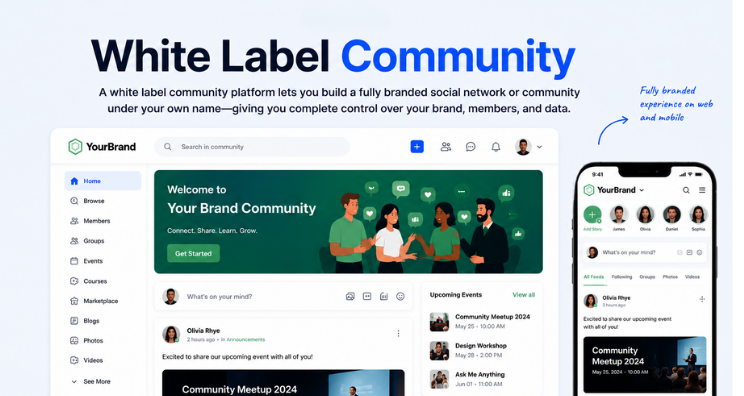
A “white label community platform” or ” white label community software” is a virtual community solution that allows you to create and manage a fully branded online community under your own identity- so it has the look and feel of your brand, not ot the brand of the company you bought it from.
Depending on the solution you choose, a white label community platform may allow you to customize:
- Your domain name
- Logos and brand elements
- Colors and visual design
- Navigation and user experience
- Mobile applications
- Community features and integrations
Having a white-label mobile app or branded app also puts your community under your logo in the App Store and Google Play Store, giving you push notifications.
Unlike chat tools or social platforms like Discord or Slack, a white-label community platform offers more than this. Beyond discussions and networking, you can create membership programs, monetize your community, host events, launch a marketplace, and customize the platform to fit your unique needs. And we already mentioned white-label apps, which Discord and Slack definitely DO NOT have.
That makes a white label community platform an ideal choice for businesses, organizations, and creators looking to build a community under their own brand—without the cost, complexity, and ongoing maintenance of developing a custom platform from scratch.
If you’re looking to launch a branded community experience, phpFox is a good option to start with:
White Label Community Platform vs Social Media Groups
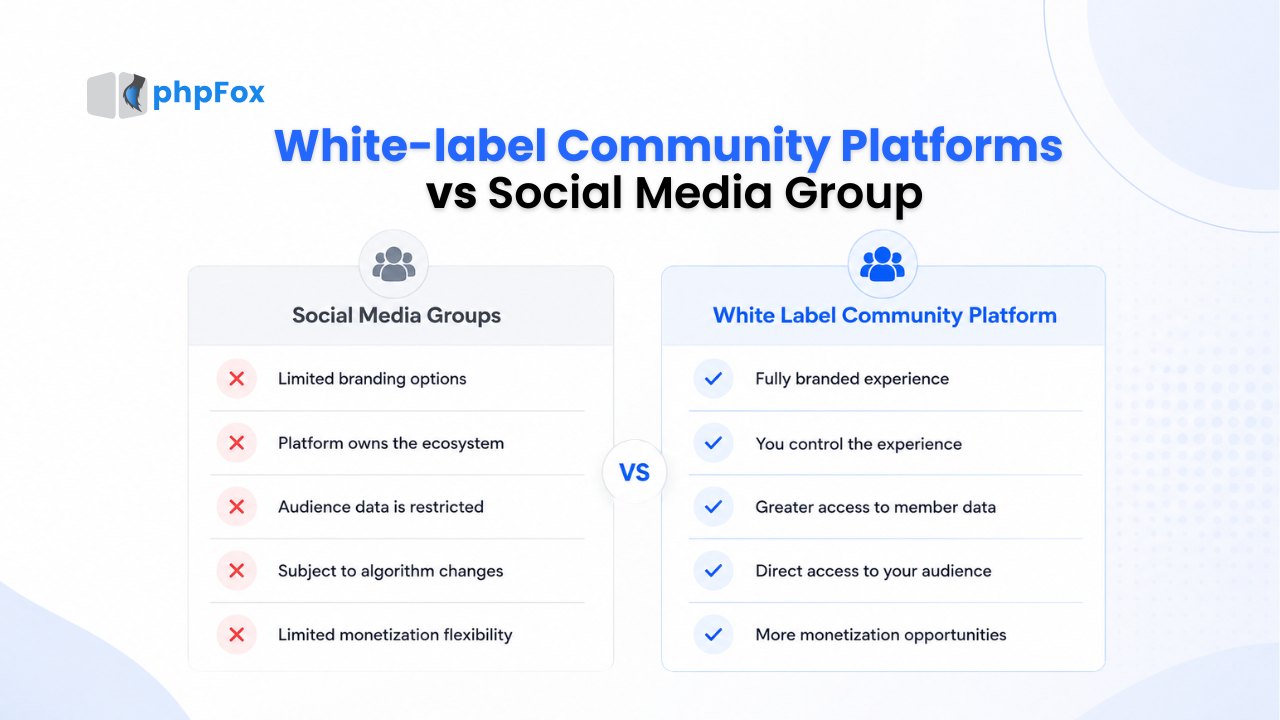
Many organizations initially build communities on platforms like Facebook, LinkedIn, Discord, or Reddit because they’re easy to set up and already have established audiences.
While these platforms can be useful for early growth, they often come with limitations.
A white label community platform gives organizations more ownership and flexibility while creating a dedicated space focused entirely on their members.
White Label Community Platform vs Custom Development
Some organizations consider building a community platform from scratch.
While this approach offers maximum control, it often requires significant investments in development, maintenance, security, infrastructure, and ongoing feature updates.
A white-label community platform offers a middle ground.
You gain the benefits of a branded community experience without the cost, complexity, and long development timelines associated with custom-built software.
For most organizations, this makes white label community software a faster and more cost-effective path to launching and scaling an online community.
Who benefits from White Label Community Platforms?
White label community platforms are used by a wide range of organizations, including:
- Membership organizations and associations
- Creators and influencers
- Online educators and coaches
- Customer communities
- Professional networks
- Nonprofits and advocacy groups
- Private membership clubs
- Specialized interest communities
Regardless of the audience, the common goal is the same: creating a community experience that strengthens relationships while maintaining ownership of the brand, audience, and long-term growth strategy.
2. How White Label Community Platform Enhances Brand Value
What Problems Does a White Label Community Platform Solve?
As communities grow, many organizations begin to encounter the same challenges.
What starts as a Facebook Group, Discord server, or third-party platform can eventually become limiting. Branding feels disconnected, audience ownership is restricted, and long-term growth becomes dependent on someone else’s platform decisions.
Here are some common challenges businesses face when building a community on social media:
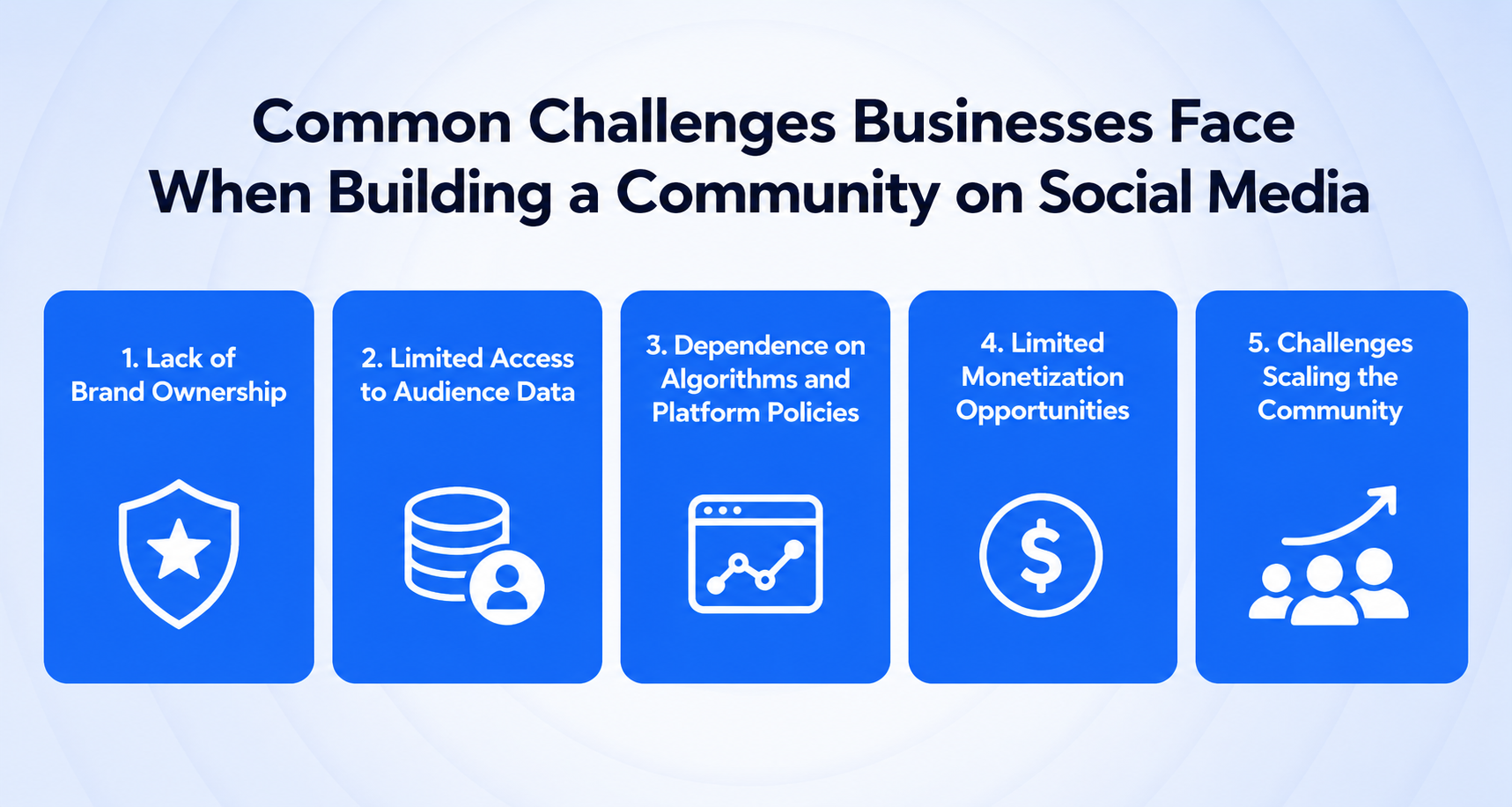
1. Lack of Brand Ownership
When your community lives on a third-party platform, your brand often takes a back seat.
Members interact with the platform’s branding, design, and user experience rather than your own. Over time, this can make it harder to create a distinct identity and strengthen brand recognition.
A white label community platform allows organizations to create a fully branded experience that feels like a natural extension of their business.
2. Limited Access to Audience Data
One of the biggest challenges with social media communities is that organizations don’t truly own the audience relationship.
Member data, engagement insights, and communication channels are often controlled by the platform itself.
White label community software gives organizations greater ownership over their member data and community insights, helping them make better decisions and build stronger relationships.
3. Dependence on Algorithms and Platform Policies
Many organizations have experienced the impact of changing algorithms, declining reach, or unexpected policy updates.
When a community depends entirely on a third-party platform, growth can be affected by factors outside your control.
With a dedicated community platform, organizations gain a more direct connection to their audience without relying on algorithm-driven visibility.
4. Limited Monetization Opportunities
As communities mature, many organizations look for ways to generate revenue through memberships, subscriptions, events, premium content, or digital products.
Not all community platforms support these business models effectively.
A white label community platform provides greater flexibility to build sustainable revenue streams while maintaining control over the member experience.
5. Challenges Scaling the Community
The tools that work for a small community don’t always support long-term growth.
As member numbers increase, organizations often need more customization, integrations, moderation capabilities, and engagement tools.
Key Benefits of a White Label Community Platform for Businesses
For business owners and founders, choosing a white label community platform is ultimately a business decision. Beyond features and design, the right platform should help reduce costs, accelerate growth, and give your organization greater control over its future.
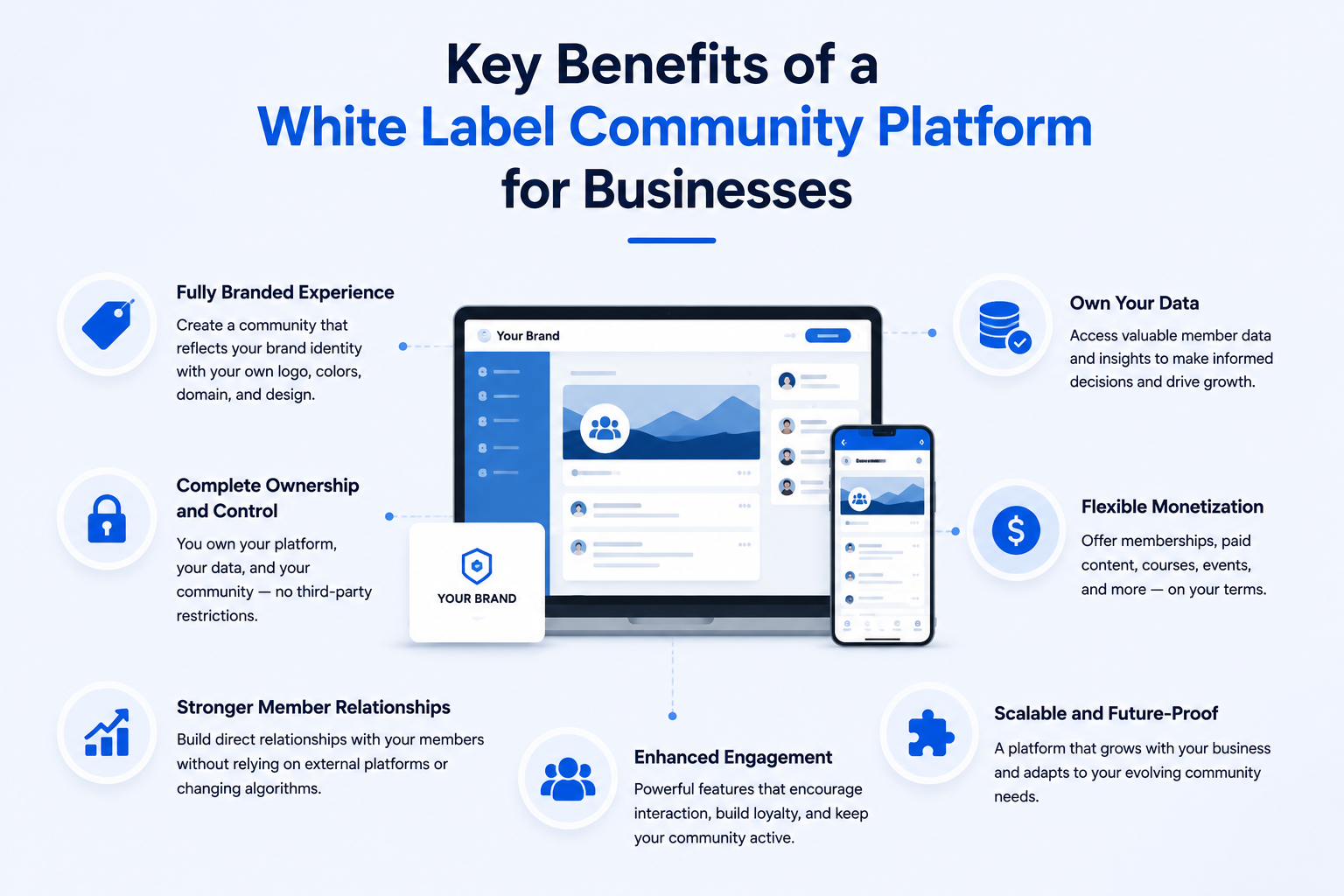
Here are some of the most important benefits businesses can expect.
1. Cost-Effective Alternative to Building from Scratch
Building a custom community platform can be expensive.
Beyond the initial development costs, organizations often need to account for ongoing expenses such as maintenance, infrastructure, security updates, bug fixes, feature development, and technical support.
A white label community platform offers many of the same benefits at a fraction of the cost.
Instead of investing significant resources into building and maintaining software, businesses can focus their budget on growing the community, acquiring members, and delivering value to their audience.
For many organizations, this significantly reduces the total cost of ownership while still providing the flexibility and branding capabilities they need.
2. Faster Time to Value
Launching a custom-built platform can take months—or even years—before users ever see the final product.
A white label community platform dramatically shortens that timeline.
Businesses can launch their communities much faster using pre-built infrastructure, proven engagement features, and existing mobile experiences. This allows organizations to start attracting members, gathering feedback, and creating value almost immediately.
More importantly, businesses can validate their community strategy sooner and begin generating results without waiting for lengthy development cycles.
The faster a community launches, the faster it can start contributing to engagement, retention, and revenue growth.
3. Maintain Ownership of Your Community
One of the biggest reasons organizations choose a white label community platform is ownership.
When communities are built entirely on social media platforms or third-party networks, businesses often have limited control over branding, audience relationships, and member data.
A white label solution provides greater ownership over the community experience, allowing organizations to build under their own brand, manage their own audience, and maintain direct relationships with members.
Instead of relying on platform algorithms or external policies, businesses gain more control over how their communities grow, evolve, and generate value over time.
For founders looking to build a long-term asset rather than simply rent access to an audience, community ownership can be one of the most valuable advantages of all.
4. Scale with Greater Flexibility
As communities grow, their requirements often become more complex.
Businesses may need additional customization, integrations, moderation tools, user permissions, or monetization capabilities.
A scalable white label community platform provides the flexibility to adapt and evolve without requiring a costly migration or complete rebuild later on.
This allows organizations to focus on growing their communities rather than outgrowing their technology.
These benefits explain why more organizations are moving away from generic community solutions and investing in platforms that offer greater flexibility, ownership, and long-term value. The next step is understanding how to choose the right one.
3. Factors to Consider When Choosing a White Label Community Platform
Not all white-label community platforms offer the same level of flexibility, ownership, or long-term value.
At first glance, many solutions appear similar. Most promise community engagement, customization, and branding capabilities. However, once your community begins to grow, the differences become much more apparent.
Before investing in a platform, here are seven factors worth evaluating carefully.
1. Branding and White-Label Capabilities
The primary reason organizations choose a white label community platform is simple: they want the community to feel like their own.
Unfortunately, not every “white label” solution delivers the same level of branding control.
Some platforms allow little more than a logo change and a few color adjustments. Others provide extensive customization options that enable organizations to create a completely branded experience from end to end.
When evaluating a platform, consider whether you can customize:
- Your domain name
- Logos and brand assets
- Colors and typography
- Navigation menus
- Community homepage layouts
- Email templates and notifications
- Mobile app branding
The goal is to create a seamless experience where members interact with your brand—not the platform provider’s.
A strong branded experience helps build trust, improve recognition, and create a stronger sense of community belonging over time.
2. Data Ownership and Member Control
Many organizations begin looking for a white label community platform after realizing they don’t truly own their audience on social media.
When your community exists entirely on a third-party platform, access to member data, engagement insights, and communication channels is often limited.
That’s why data ownership should be one of the most important considerations during your evaluation process.
Ask questions such as:
- Who owns the member data?
- Can member information be exported?
- What analytics are available?
- Are there any restrictions on audience communication?
- Can the platform support compliance requirements?
The ability to access and understand your community data allows you to make better decisions, personalize member experiences, and build stronger long-term relationships.
More importantly, it ensures your community remains an asset that you control rather than one that depends entirely on another platform’s ecosystem.
3. Community Engagement Features
A beautifully branded platform means very little if members have no reason to return.
The most successful communities create opportunities for ongoing participation, conversations, and relationship building.
When evaluating white label community software, look beyond branding and focus on engagement capabilities.
Important features often include:
- Activity feeds
- Discussion forums
- Groups and subcommunities
- Direct messaging
- Events and webinars
- Livestreaming
- Polls and surveys
- Notifications and announcements
The right combination of engagement tools can transform a community from a static content hub into an active destination where members regularly connect and contribute.
Communities thrive when participation feels natural and rewarding, not forced.
4. Mobile Experience and Native Apps
Today’s communities are increasingly mobile-first.
Members expect to stay connected wherever they are—whether they’re commuting, traveling, attending events, or simply browsing during spare moments throughout the day. If your community experience doesn’t work well on mobile devices, engagement can suffer significantly.
When evaluating a white label community platform, it’s important to look beyond responsive web design.
Consider questions such as:
- Does the platform offer native iOS and Android apps?
- Can the mobile app be branded with your logo and identity?
- Are push notifications supported?
- Can members access all key features from mobile devices?
- Is the user experience consistent across desktop and mobile?
Native mobile apps can play a major role in increasing engagement because they make it easier for members to stay connected and participate in community activities throughout the day.
As mobile usage continues to grow, choosing a platform with a strong mobile experience is no longer a nice-to-have—it’s becoming an essential requirement.
5. Monetization Options
Not every community is designed to generate revenue.
However, many organizations eventually discover opportunities to monetize their audience through memberships, subscriptions, premium content, events, courses, sponsorships, or digital products.
Even if monetization isn’t part of your immediate strategy, it’s worth considering how your needs may evolve in the future.
Look for platforms that support:
- Paid memberships
- Subscription plans
- Premium groups
- Exclusive content access
- Event ticketing
- Digital product sales
- Advertising opportunities
- Marketplace functionality
The last thing you want is to outgrow your platform because it can’t support new business models.
Choosing a white label community platform with built-in monetization flexibility gives your organization more options as your community matures.
6. Customization and Integrations
Every community is different.
A creator community has different requirements than a membership organization. A customer community operates differently from a private social network.
That’s why flexibility matters.
The best white label community platforms allow organizations to adapt the experience to their unique goals rather than forcing them into a predefined structure.
When evaluating solutions, consider:
- API availability
- CRM integrations
- Marketing automation integrations
- Single sign-on (SSO)
- Custom workflows
- Third-party app connections
- Custom feature development options
Integrations are particularly important because communities rarely operate in isolation.
Your community platform should work seamlessly with the tools you already use instead of creating additional operational complexity.
The more connected your ecosystem becomes, the easier it is to deliver a smooth experience for both members and administrators.
7. Scalability and Long-Term Growth
It’s easy to focus on what your community needs today.
The better question is what your community will need two or three years from now.
Many organizations launch communities with a few hundred members and quickly discover that growth introduces entirely new challenges.
As communities expand, you may need:
- More advanced moderation tools
- Additional engagement features
- Higher performance infrastructure
- Multi-language support
- More complex user permissions
- Expanded monetization capabilities
- Additional integrations
Migrating communities from one platform to another can be expensive, time-consuming, and disruptive to member engagement.
That’s why scalability should be a core consideration from the very beginning.
The right white label community platform should support your current needs while providing enough flexibility and capacity to grow alongside your audience.
A platform that can scale effectively will save significant time, resources, and frustration in the future.
4. Steps to Choose the Right White Label Community Platform
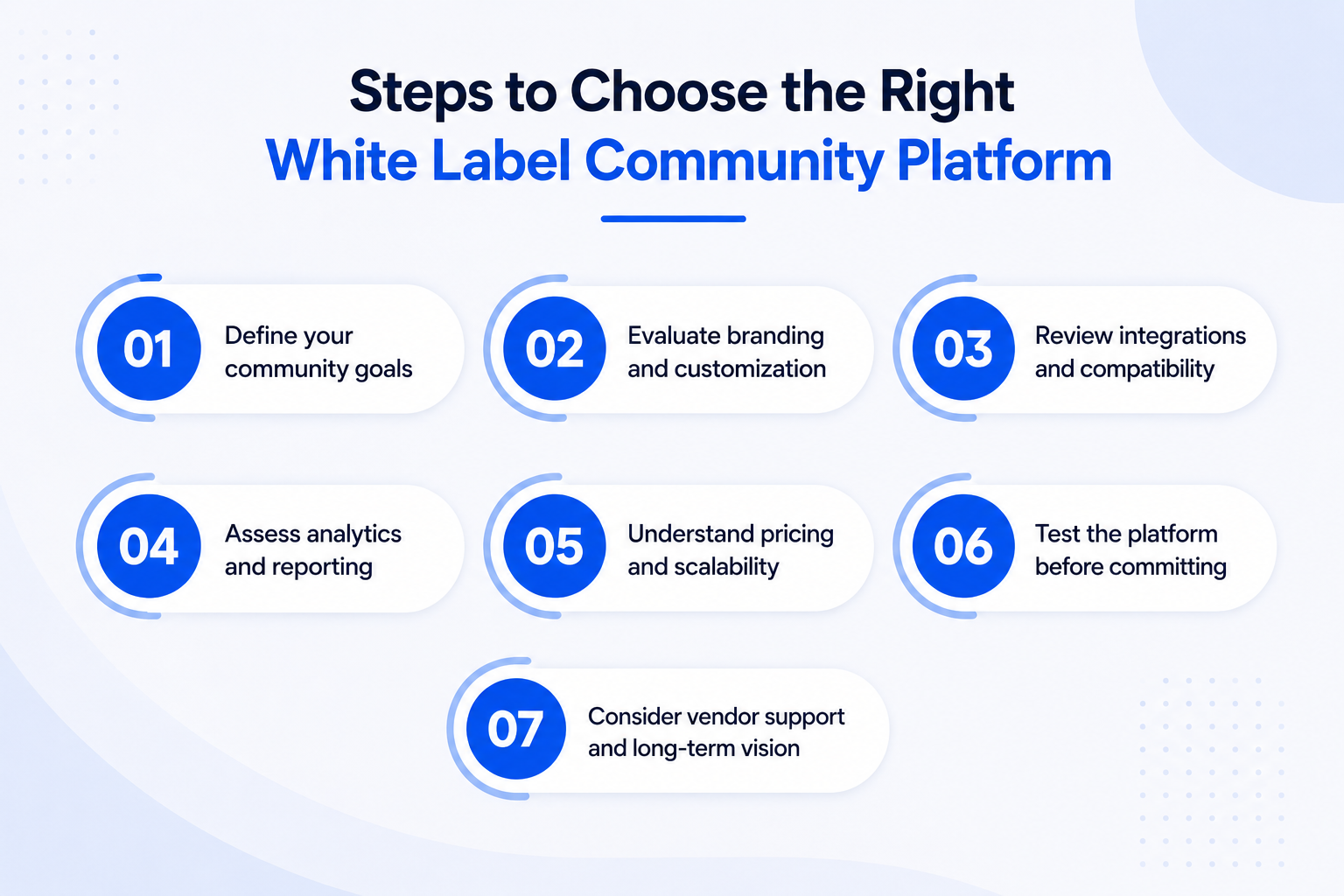
1. Define Your Community Goals:
Before comparing platforms, identify what success looks like for your community. Are you focused on customer engagement, memberships, education, networking, or creator monetization? Understanding your primary goals will help narrow down the features that truly matter.
2. Evaluate Branding and Customization:
A white label community platform should feel like an extension of your brand. Look beyond logos and colors to evaluate how much control you have over layouts, navigation, user experience, and mobile branding.
3. Review Integrations and Technical Compatibility:
Your community shouldn’t operate in a silo. Make sure the platform integrates with the tools you already use, such as CRM systems, email marketing software, payment gateways, and learning management systems.
4. Assess Analytics and Reporting:
Data helps you understand what’s working and where improvements are needed. Look for platforms that provide insights into member engagement, content performance, retention, and overall community health.
5. Understand Pricing and Scalability:
Don’t focus solely on the starting price. Consider how costs may change as your community grows and whether the platform can support your long-term needs without requiring a migration later.
6. Test the Platform Before Committing:
Whenever possible, take advantage of free trials or demos. Testing the platform with real users can reveal usability issues, onboarding challenges, and feature gaps that aren’t obvious during a sales presentation.
7. Evaluate Vendor Support:
A great platform is only part of the equation. Responsive support, clear documentation, and an active product roadmap can make a significant difference as your community evolves over time.
5. Common Mistakes to Avoid When Choosing a White Label Community Platform
Choosing a platform is a long-term decision, and it’s easy to focus on the wrong criteria during the evaluation process.
Here are some common mistakes organizations make:
Choosing Based on Price Alone: Cost matters, but the cheapest option isn’t always the most cost-effective. A platform that lacks critical features or requires migration later can end up costing far more in the long run.
Overlooking Data Ownership: Many organizations don’t realize the importance of data ownership until they need access to audience insights, communication tools, or migration options. Always understand what level of control you’ll have over your member data.
Ignoring Mobile Experience: A growing percentage of community engagement happens on mobile devices. Choosing a platform with a weak mobile experience can negatively impact participation and retention.
Underestimating Future Growth: Communities evolve. What works for your first 500 members may not work for your next 50,000. Always evaluate platforms with future growth in mind.
Focusing Only on Features: A long feature list doesn’t automatically mean a better platform. Ease of use, flexibility, support, scalability, and member experience are often just as important as the number of available features. By avoiding these common mistakes, you’ll be in a stronger position to choose a white label community platform that supports both your current needs and your long-term vision.
6. Final Thoughts
Choosing the right platform isn’t just about comparing feature lists. It’s about finding a solution that aligns with your long-term vision, supports your community goals, and can grow alongside your members.
The best white label community platform should help you create a branded experience, maintain ownership of your audience, and provide the flexibility to scale as your community evolves. By taking the time to evaluate your options carefully, you’ll be better positioned to build a community that delivers lasting value for both your organization and your members.
If you’re looking for a fully customizable white label community platform with powerful social networking features, native mobile apps, flexible monetization options, and complete ownership of your data, phpFox is worth exploring.
Start your free trial today and see how phpFox can help you build, grow, and own your online community.