
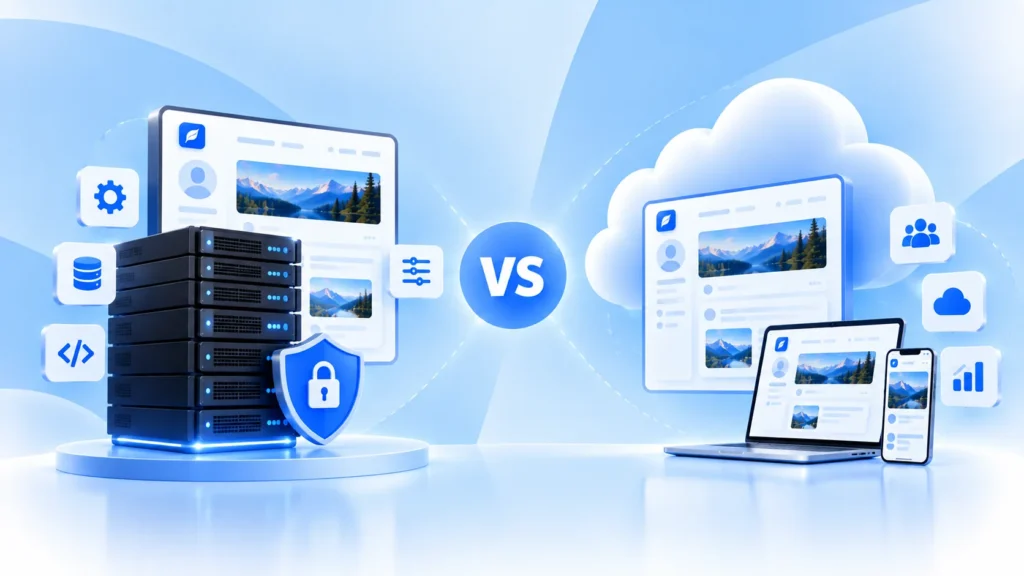
When choosing a platform to build your online community, it’s easy to focus on features, pricing, or how quickly you can launch. Those things matter—but they’re only part of the decision.
The bigger question is how much control you want over your community in the long run. SaaS platforms make it easy to get started, while self-hosted social network software gives you full ownership of your platform, your member data, and the flexibility to customize as your business grows. Each approach comes with its own trade-offs, and the right choice depends on what you’re building.
In this guide, we’ll compare self-hosted social network software and SaaS community platforms across the areas that matter most—from ownership and customization to costs, scalability, and long-term flexibility—so you can choose the solution that best fits your goals.
What Is Self-Hosted Social Network Software?
Self-hosted social network software is community software that you install on your own hosting infrastructure instead of using a platform owned by another company.
That means you control the software, your database, your member information, and how your community evolves over time.
Imagine you’ve opened a coffee shop.
A SaaS platform is like renting a fully furnished store. You can start serving customers tomorrow, but there are rules about what you can change. The landlord decides the building policies, raises the rent when the contract renews, and ultimately owns the property.
A self-hosted platform is closer to owning the building.
It usually takes more effort at the beginning, but every improvement you make belongs to you. You decide how the space looks, how it operates, and no one can suddenly change the terms because of a new company policy.
In practical terms, self-hosted social network software usually gives you:
- Full ownership of your community database and member data
- Freedom to choose your own hosting provider or cloud infrastructure
- Complete control over branding, design, and custom features
- Greater flexibility to integrate with your existing business systems
- Independence from unexpected pricing changes or platform restrictions
This model is often chosen by businesses that see their community as a long-term business asset rather than just another marketing channel.
Platforms like phpFox are built around this approach, allowing organizations to create a fully branded community—including their own web platform and native mobile apps—while keeping complete ownership of their data and infrastructure.

? Explore more: Read our Ultimate Guide to Social Networking Software to learn everything you need to know about social networking software before choosing the right solution for your business.
What Is a SaaS Platform?
A SaaS (Software as a Service) community platform works very differently.
Instead of installing software yourself, you simply create an account and start building. The provider hosts everything, handles updates, manages security, and takes care of the technical side.
That’s exactly why platforms like Circle, Mighty Networks, or Kajabi have become so popular. They’re incredibly easy to get started with.
If you’re validating a new community idea, launching a paid membership, or simply want to avoid technical setup, SaaS can be a smart choice.
In fact, we often recommend founders start there when speed matters more than ownership. However, the trade-off becomes more noticeable as your community grows. Because the platform owns the infrastructure, there are always limits to what you can control. Depending on the provider, you may eventually run into things like:
- Monthly subscription fees that increase as your community expands
- Restrictions on branding or white-label customization
- Limited flexibility for custom integrations or unique workflows
- Revenue-sharing or transaction fees on memberships and digital products
- Platform policies that can affect how your community operates
None of these are necessarily deal-breakers. For many creators, the convenience is absolutely worth it.
The important question isn’t whether SaaS is good or bad.
It’s whether you expect your community to remain a marketing channel, or eventually become a core business asset that you want to own completely. That distinction is what leads many established community builders to eventually consider self-hosted social network software as the next step.
Here’s the short version, side by side — self-hosted social network software against the SaaS alternative, factor by factor.
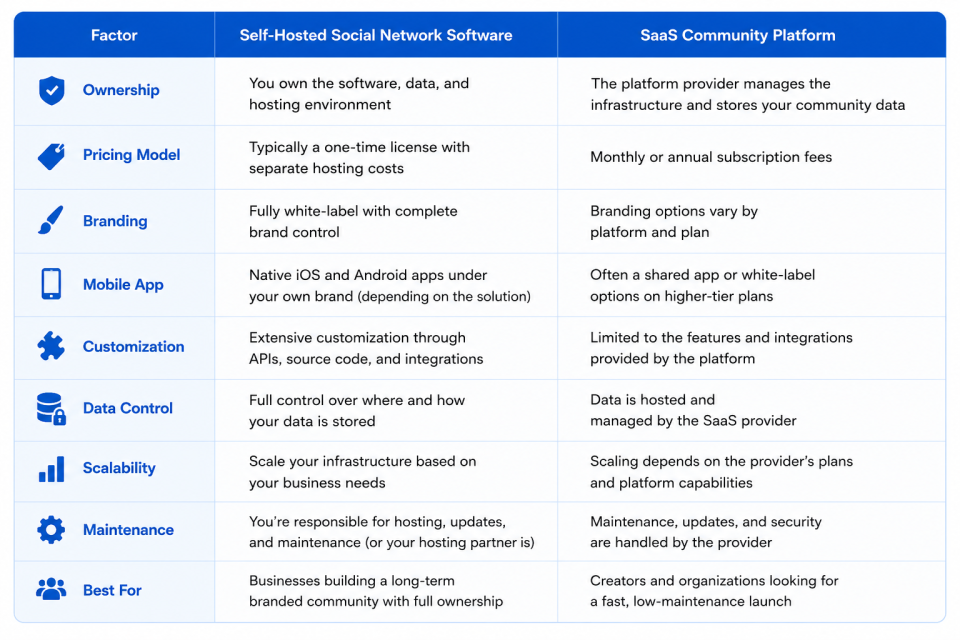
7 Key Differences Between Self-Hosted Social Network Software and SaaS Platforms
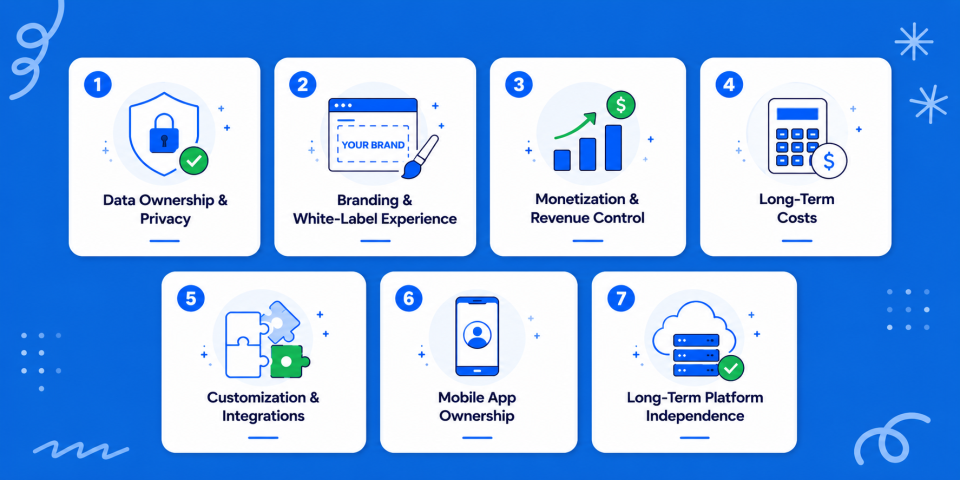
1. Data Ownership & Privacy
One of the biggest differences between self-hosted social network software and SaaS platforms is who owns and controls your data.
With a SaaS platform, your community data—including member profiles, discussions, uploaded content, and analytics—is stored on the provider’s infrastructure and managed according to their policies.
With a self-hosted solution, your data is stored on servers that you control, giving you full ownership and greater flexibility over how information is managed, backed up, and secured.
This can be especially important for organizations that handle sensitive information or need to meet internal security, privacy, or compliance requirements.
2. Branding & White-Label Experience
Branding plays a much bigger role than simply adding your logo.
Many SaaS platforms allow basic customization, such as changing colors or uploading your brand assets. However, the overall product experience—including the mobile app and user interface—is often still tied to the platform’s own ecosystem.
With self-hosted social network software, you have complete control over your community’s identity. Your website, domain, branding, and even your native mobile apps can reflect your own business instead of another company’s platform.
For businesses building a long-term brand, that level of ownership creates a more consistent experience for members.
3. Monetization & Revenue Control
If your community generates revenue through memberships, subscriptions, online courses, or digital products, it’s worth understanding how each platform handles payments.
Many SaaS platforms charge recurring subscription fees and, depending on the provider, may also apply transaction or revenue-sharing fees for certain monetization features.
Most self-hosted social network software follows a different model. Instead of taking a percentage of your revenue, you typically purchase a software license and keep full control over how your business earns and processes payments.
As revenue grows, this model can provide greater flexibility and predictability.
4. Long-Term Costs
SaaS platforms generally have a lower barrier to entry.
Monthly subscriptions make it easy to launch quickly without a large upfront investment, making them an attractive option for new communities.
However, costs often increase over time as your member base grows or as you need access to higher-tier plans and additional features.
With self-hosted social network software, the initial investment is typically higher because you’re purchasing the platform and hosting infrastructure. But since licensing costs are often fixed, the total cost of ownership can become more economical over the long term for growing communities.
5. Customization & Integrations
Every community has unique requirements.
Some businesses simply need discussion forums, while others want to integrate CRMs, payment gateways, learning management systems, marketing automation tools, or build entirely custom features.
SaaS platforms usually provide built-in features and selected integrations, but customization is limited to what the platform allows.
By contrast, self-hosted social network software gives developers access to the underlying platform, APIs, and architecture, making it easier to customize workflows and build features that fit specific business needs.
6. Mobile App Ownership
Mobile engagement has become an important part of growing online communities.
Many SaaS providers offer a shared mobile application where multiple communities exist within the same app, with branding options limited by the platform.
With a self-hosted solution such as phpFox, organizations can publish fully branded native iOS and Android apps under their own business name. Members download your app, see your logo, receive notifications from your brand, and interact within an experience designed specifically for your community.
For organizations focused on building long-term brand recognition, this can make a significant difference.
7. Long-Term Platform Independence
Choosing a community platform is a long-term decision.
With a SaaS platform, your community operates within the provider’s ecosystem. Pricing, available features, product direction, and platform policies are ultimately controlled by the vendor.
Self-hosted social network software offers greater independence. Since you own the platform and your data, you have more flexibility to decide how your community evolves, when to upgrade, what integrations to build, and how your business operates over time.
For organizations planning to grow their community into a long-term digital asset, this level of control is often one of the strongest reasons to choose a self-hosted solution.
Which One Should You Choose?
The truth is, there’s no one-size-fits-all answer.
Both SaaS platforms and self-hosted social network software have their strengths. The right choice depends on where your community is today—and where you want it to be in the future.
A SaaS platform may be the better fit if you:
- Want to launch your community as quickly as possible
- Are still validating your idea or testing market demand
- Have a limited budget for getting started
- Prefer a platform where hosting, maintenance, and updates are managed for you
- Don’t require extensive customization or advanced integrations
For many creators, startups, and small businesses, SaaS is a practical way to get a community off the ground with minimal technical effort.
On the other hand, self-hosted social network software is worth considering if you:
- View your community as a long-term business asset rather than a short-term project
- Want complete ownership of your member data and platform
- Need full control over branding and the overall member experience
- Plan to monetize through memberships, subscriptions, online courses, or digital products
- Expect your community to grow and require custom features or integrations in the future
- Need greater flexibility to meet your organization’s security, compliance, or privacy requirements
While self-hosted social network software often requires a larger investment upfront, many organizations find that it offers greater flexibility and a lower total cost of ownership as their community grows.
Ultimately, the decision comes down to your long-term goals.
If you’re simply looking for the fastest way to launch, a SaaS platform may be all you need today.
But if you’re building a branded community that you plan to grow, monetize, and own for years to come, investing in self-hosted social network software can provide a stronger foundation for the future.
Final Thoughts
Choosing between a SaaS platform and self-hosted social network software isn’t about finding the “better” option—it’s about choosing the solution that aligns with your long-term goals.
If your priority is launching quickly with minimal setup, a SaaS platform can be a great starting point. But if you’re building a community that’s central to your business, investing in a platform you fully own can provide greater flexibility, stronger branding, and more control as your community grows.
At the end of the day, your community is more than just a place for conversations. It’s an asset that represents your brand, your audience, and your business. Choosing the right foundation today can make it much easier to scale tomorrow.
Looking for a self-hosted social network software solution that gives you complete ownership, white-label branding, and native mobile apps? Explore phpFox and see how you can build a fully branded online community on your own terms.