Every growing organization reaches a point where communication becomes more complicated than it should be.
Employees collaborate in Slack. Customers ask questions in Facebook Groups. Members exchange ideas through email. Partners use different messaging apps. Before long, conversations are spread across multiple platforms, making it difficult to keep everyone informed, engaged, and connected.
An enterprise social network solves this challenge by bringing your people together in one secure, centralized platform.
Whether you’re building an employee community, a customer community, a professional member network, or a private collaboration space, an enterprise social network creates a shared digital environment where people can communicate, exchange knowledge, participate in discussions, and build stronger relationships under your organization’s brand.
In this guide, we’ll explain what an enterprise social network is, the key benefits it offers, how it compares with social media and workplace collaboration tools, and how to choose the best enterprise social network platform for your organization’s needs.
What is an enterprise social network?
An enterprise social network is a private, structured platform where an organization’s people — employees, members, customers, or partners — communicate and collaborate through profiles, groups, activity feeds, and discussions, similar in feel to public social media but built specifically for one organization.
Enterprise social networks have been around for years. Early platforms like Yammer helped companies connect employees through private social networks, while Meta launched Workplace in 2016 as its own workplace collaboration platform. However, when Meta announced it would shut down Workplace in 2024, many organizations were forced to migrate their communities and data to new platforms.
That highlighted an important lesson: choosing an enterprise social network isn’t just about the features available today. It’s also about how much control you have over your platform and whether it can support your organization in the long run.
Today’s enterprise social networks do much more than provide an internal news feed or chat. Many platforms now support customer communities, paid memberships, knowledge sharing, events, and branded mobile apps. Some also give organizations full ownership through self-hosting, while others operate as SaaS platforms where the vendor manages the infrastructure.
Enterprise Social Network Vs Social Media
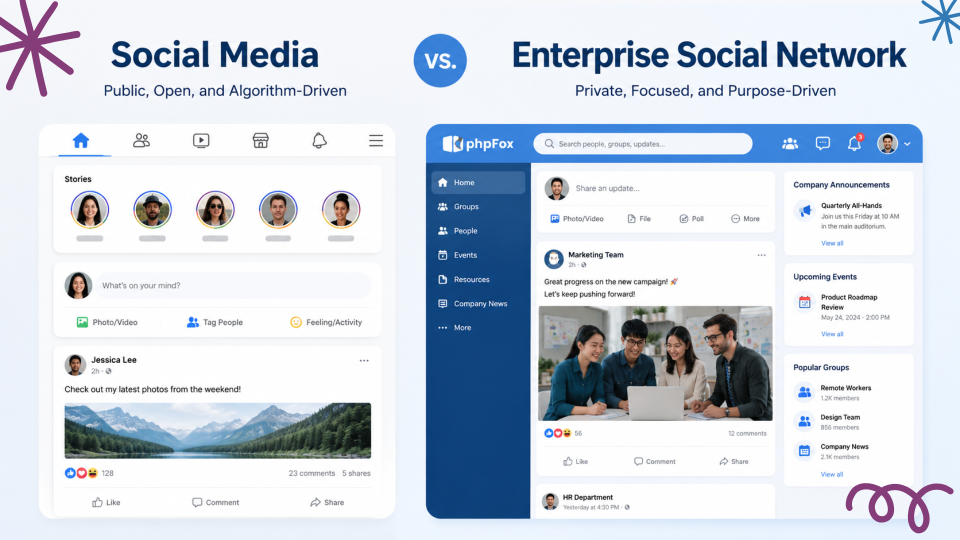
Public platforms like Facebook, LinkedIn, and Instagram connect people across the open internet, with an algorithm deciding what gets seen and a company that isn’t yours setting the rules.
An enterprise social network flips that. It’s a private, secure space built around one organization’s people and purpose — not a slice of someone else’s feed. There’s no competing algorithm, no public visibility, and no risk of policy changes disrupting how members or employees connect.
An enterprise social network isn’t designed to replace social media—it serves a completely different purpose. Social media helps organizations reach external audiences, while an enterprise social network helps them strengthen relationships with the people who already matter most: employees, members, customers, and partners.
Below is the side-by-side comparison at a glance:
| Feature | Enterprise Social Network | Social Media |
| Primary purpose | Internal communication, collaboration, and knowledge sharing | Public networking, content sharing, and marketing |
| Best for | Organizations, businesses, employee communities, and member networks | Individuals, brands, influencers, and public audiences |
| Audience | Employees, members, customers, or invited users | Anyone with a public or platform account |
| Privacy | Private, invitation-only, with role-based access | Mostly public or platform-controlled privacy settings |
| Content structure | Structured with groups, departments, knowledge bases, and searchable discussions | Chronological feeds driven by platform algorithms |
| Employee or member directory | Built-in, searchable profiles | Not designed for organizational directories |
| Branding | Fully branded with your organization’s identity | Platform branding (Facebook, LinkedIn, X, etc.) |
| Platform ownership | The organization owns the platform (self-hosted) | Platform owned by the social media provider |
| Data ownership | The organization controls employee and member data | The platform provider manages user data |
| Mobile app | Dedicated enterprise or white-label mobile app | Generic social media app |
| Security & compliance | Enterprise-grade permissions and access control | Limited control over platform policies and data |
Enterprise Social Network vs. Slack
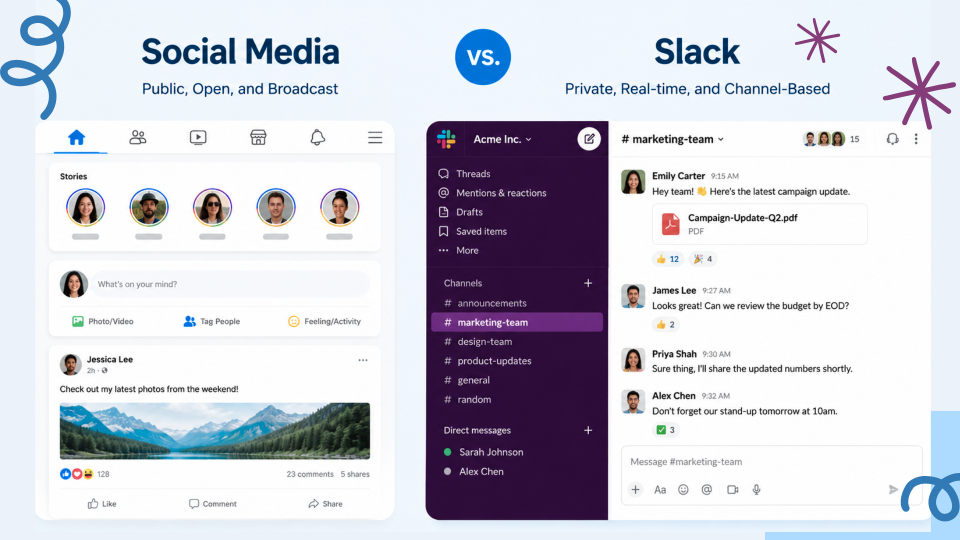
Slack is a real-time messaging tool built for fast, internal communication between coworkers — channels, direct messages, threads. An enterprise social network is a broader platform built for structured, ongoing community: profiles, groups, content feeds, knowledge sharing, and often access for people beyond internal staff, like customers or members.
If the problem is “our team needs to talk faster,” Slack solves it. If the problem is “we need a place where thousands of employees, customers, or members can connect, find content, and stay engaged over time,” that’s an enterprise social network’s job.
What Slack Actually Does Well
Slack earned its place in the workplace for a reason. It’s fast, familiar, and genuinely good at what it was built for.
Real-time messaging. Channels and direct messages make quick back-and-forth conversation effortless, especially for small to mid-sized teams working closely together.
Deep tool integrations. Slack connects to an enormous ecosystem — project management tools, CI/CD pipelines, calendars, support systems — making it a strong hub for operational, day-to-day work coordination.
Low learning curve. Almost everyone already knows how to use it. Onboarding a new employee onto Slack takes minutes, not a training session.
Where Slack runs into limits is scale and structure. Conversations live and die in channels with no real content architecture behind them. There’s no member directory built for a large audience, no native space for long-form knowledge sharing, and nothing resembling a public-facing profile or community layer. It’s also strictly internal — Slack Connect allows some external collaboration, but it was never designed to host a customer or member community at scale.
What an Enterprise Social Network Does Well
An enterprise social network is built around a different unit of organization: not the channel, but the person and the community around them.
Structured profiles and directories. People can find each other, see who does what, and build a real sense of “who’s in this organization,” which matters far more once headcount or membership crosses into the thousands.
Groups and content feeds. Instead of conversation disappearing into the scroll, an enterprise social network organizes discussion around topics, teams, or interests, with content that stays discoverable over time.
Knowledge sharing at scale. Many platforms include searchable knowledge bases or pinned resources, which solve the problem of the same question getting asked — and answered — five different times in five different channels.
Reach beyond internal staff. This is the biggest structural difference. An enterprise social network can extend to customers, members, alumni, or partners — not just employees — which makes it the right tool for associations, membership businesses, and customer communities in a way Slack simply isn’t built for.
Branding and ownership. Depending on the platform, an enterprise social network can be fully white-labeled and even self-hosted, meaning the organization owns the data, the branding, and the platform itself — rather than renting space inside someone else’s product.
Side-by-Side Comparison
| Slack | Enterprise Social Network | |
| Primary purpose | Real-time internal messaging | Structured, ongoing community and collaboration |
| Best for | Fast coordination between coworkers | Large employee, member, or customer communities |
| Audience reach | Internal team (limited external via Slack Connect) | Internal staff, and often external members or customers |
| Content structure | Channels and threads, mostly ephemeral | Profiles, groups, feeds, knowledge bases |
| Member/employee directory | Basic | Built-in, searchable |
| Branding | Slack’s own interface | Often fully white-labeled |
| Mobile app | Generic Slack app | Branded native app on some platforms |
| Monetization tools | None | Available on some platforms (memberships, subscriptions) |
| Data ownership | Vendor-hosted (Slack/Salesforce) | Vendor-hosted or self-hosted, depending on the platform |
| Typical scale | Small to mid-sized teams | Hundreds to tens of thousands of people |
Why Do Organizations Need an Enterprise Social Network?
Research consistently links strong internal and member communication to better engagement and lower friction across an organization. But the practical case is simpler than any study: most organizations already have the people. What they’re missing is a single place to hold them together.
Without an enterprise social network, communication splits across email threads nobody reads in full, a Slack workspace that only covers internal staff, a Facebook group the organization doesn’t own, and an events tool that isn’t connected to any of it. Each tool solves a fragment of the problem and leaves the rest unaddressed.
An enterprise social network consolidates that into one hub — a digital home where people communicate, collaborate, and stay engaged, instead of being asked to check five different places to find out what’s going on.
The Major Benefits of an Enterprise Social Network
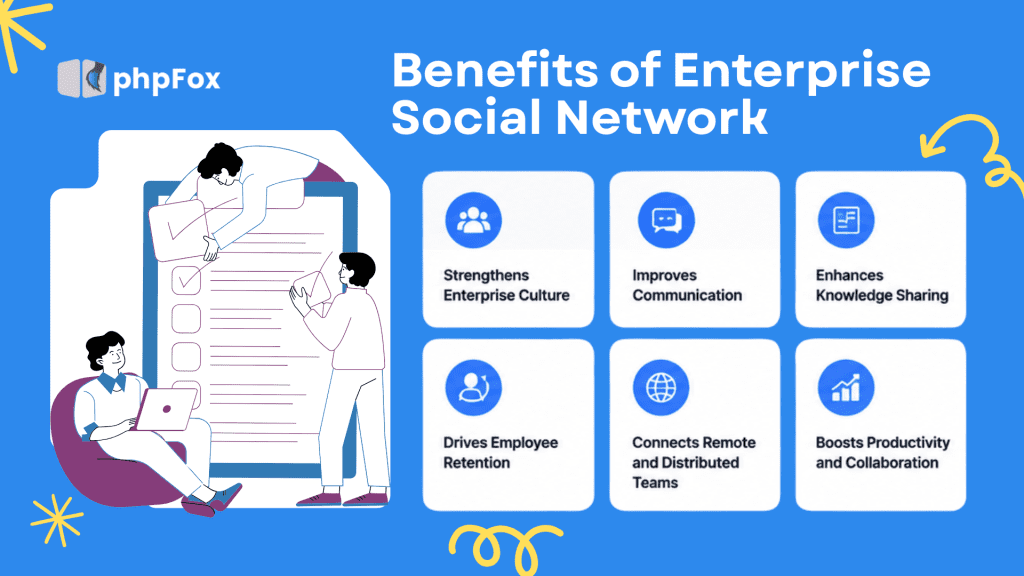
A well-implemented enterprise social network does more than centralize chat. Here’s where organizations typically see the clearest impact.
Strengthens enterprise culture and identity
Keeping a shared culture alive is easy in a small office and hard across multiple locations, time zones, or — for member-based organizations — a geographically scattered audience. An enterprise social network breaks down those barriers, giving leaders and members a shared space that reflects what the community is actually doing and talking about, not a sanitized version filtered through official channels.
Builds transparency and trust
When leadership posts, answers questions, or runs a poll directly on the platform, it changes how people experience the organization. Members or employees stop feeling like they’re on the outside of decisions and start feeling like part of the process — which is a meaningfully different relationship than one built on one-way newsletters.
Improved Communication
Research has found that enterprise social media improves workplace integration, which in turn enhances employee performance and collaboration. Employees using enterprise social platforms are better connected across the organization and experience more positive workplace interactions.
Instead of conversations getting buried in inboxes, an enterprise social network organizes discussion into groups and feeds tied to specific topics, teams, or interests. People only see what’s relevant to them, and conversations stay findable instead of disappearing into a thread nobody can locate two weeks later.
Makes knowledge sharing actually work
Large organizations often have the answer to a problem sitting in one person’s head, with no easy way for anyone else to find it. An enterprise social network turns one-off answers into searchable, shared knowledge — useful for onboarding new members or employees, and for avoiding the same question being asked, and answered, five separate times.
Keeps remote and distributed members connected
For organizations with remote employees, distributed members, or chapters spread across regions, an enterprise social network is often the only practical way to maintain a real sense of belonging. It gives people a place to ask questions, share work, and stay looped into culture without needing to be in the same room — or even the same country.
Drives efficiency, retention, and — for member-based organizations — revenue
Beyond communication, a well-run enterprise social network speeds up collaboration and shortens onboarding. For organizations that monetize their community — associations, membership businesses, course creators, coaching programs — the platform also becomes a direct revenue channel through memberships, subscriptions, and gated content, not just a communication tool.
Top Features to Look for in an Enterprise Social Network
Not every platform in this category is built the same way. Here are the features worth prioritizing when evaluating one.
- Access for everyone who needs it: The platform shouldn’t be limited to people with a corporate email address. Frontline staff, external members, or customers without an internal login still need a way in.
- A central activity feed —where people can post updates, images, videos, and documents —is usually the heart of the platform—the place everyone checks to stay current.
- Real interaction, not just posting: Likes, comments, shares, hashtags, and mentions turn a feed from a bulletin board into an actual conversation.
- Member or employee profiles: A searchable directory makes it possible to find the right person, locate an expert, or simply put a face to a name across a large organization.
- Groups and communities: People should be able to follow topics and join smaller groups inside the larger network — this is usually what determines what shows up in their personal feed.
- Integration with existing tools: A platform that connects with the CRMs, payment systems, or communication tools an organization already runs avoids forcing a full operational rebuild just to adopt it.
- Structured collaboration spaces: Dedicated spaces or groups for specific teams, projects, or topics keep discussion organized instead of dumping every conversation into one undifferentiated feed.
- Recognition and engagement tools: badges, featured members- give people a reason to stay active on the platform instead of treating it as one more obligation.
- A direct channel for leadership and announcements: Updates, announcements, and longer-form posts give leaders a way to communicate directly with the whole organization, without it getting lost in email.
- Branding and ownership: This is the feature most comparison guides skip — and the one that determines what happens five years from now. A platform that’s fully white-labeled, with the organization’s own branding, native mobile apps, and ownership of the underlying data, isn’t exposed to a vendor’s pricing changes, feature removals, or shutdown in the way Workplace from Meta’s customers were in 2024.
Who Should Use an Enterprise Social Network?
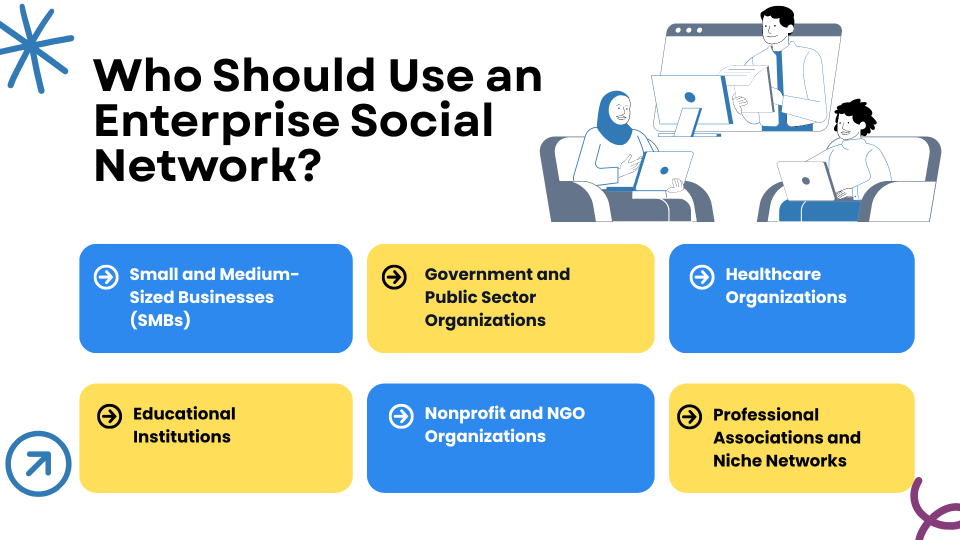
Enterprise social networks aren’t just for Fortune 500 companies. Any organization that relies on people to communicate, collaborate, and share knowledge can benefit from having a centralized digital workplace.
Here are the organizations that gain the most value from an enterprise social network.
- Small and Medium-Sized Businesses (SMBs)
Growing businesses often start with email and messaging apps, but those tools quickly become difficult to manage as teams expand.
An enterprise social network helps SMBs establish better communication habits early by bringing announcements, discussions, documents, events, and employee collaboration into one platform. Instead of adopting multiple disconnected tools, businesses can build a digital workplace that grows alongside their organization.
- Government and Public Sector Organizations
Government agencies often need secure internal communication while connecting employees across different departments and regional offices.
An enterprise social network provides a centralized environment where staff can access policy updates, share knowledge, collaborate on initiatives, and communicate more effectively—all within a private platform that the organization controls.
- Healthcare Organizations
Hospitals, healthcare providers, and medical organizations depend on timely communication across clinical and administrative teams.
An enterprise social network makes it easier to distribute internal announcements, share best practices, organize department-specific communities, and improve collaboration without relying solely on email or fragmented communication channels. It also supports continuous learning by giving employees easy access to training materials and organizational knowledge.
- Educational Institutions
Universities, colleges, schools, and training organizations often need to connect faculty, staff, researchers, and administrators across multiple campuses or departments.
An enterprise social network creates a collaborative space where employees can share resources, coordinate events, exchange ideas, and strengthen communication across the institution. It also helps preserve institutional knowledge that can be accessed long after conversations take place.
- Nonprofit and NGO Organizations
Many nonprofits operate with distributed teams, volunteers, and regional offices. Keeping everyone informed while maintaining a strong organizational culture can be challenging.
An enterprise social network provides a shared space for announcements, volunteer coordination, project discussions, fundraising initiatives, and organizational updates, helping employees and volunteers stay connected regardless of location.
- Professional Associations and Niche Networks
For professional communities, exclusivity is part of the value. A branded community app gives members a dedicated space to network, exchange knowledge, attend events, and access member-only resources. It also strengthens your organization’s identity by putting your brand—not a third-party platform—at the center of every interaction.
Create an Engaging Community for Employees and Members with phpFox
Building an enterprise social network is about more than improving communication—it’s about creating a workplace where employees feel informed, connected, and engaged.
phpFox provides everything organizations need to build a secure, branded digital workplace that encourages collaboration, strengthens company culture, and keeps people connected across every department.
- Rich Member Profiles
Help employees get to know the people behind the job titles.
With detailed member profiles, employees can showcase their expertise, interests, departments, and contact information, making it easier to discover colleagues, build relationships, and collaborate across teams. A searchable employee directory also helps new hires integrate into the organization faster.
- White Label Mobile App
Keep your organization connected wherever employees work.
The phpFox White Label Mobile App gives your organization a fully branded iOS and Android app published under your own business name. Employees can receive push notifications, join discussions, access company updates, and collaborate from anywhere—whether they’re in the office, working remotely, or traveling.
- Enterprise Privacy & Security
Your organization’s conversations and employee data should remain under your control.
As a self-hosted platform, phpFox gives you complete ownership of your data while allowing administrators to manage user roles, permissions, privacy settings, and access control. Whether you’re creating private departments, executive groups, or organization-wide communities, you decide who can access what.
- Collaboration Tools That Keep Everyone Connected
Bring communication, collaboration, and knowledge sharing together in one place.
Employees can create groups, join discussions, exchange private messages, share files, publish announcements, organize events, conduct polls, and collaborate across departments—all from a single platform. Instead of switching between multiple disconnected tools, your organization has one centralized hub for internal communication.
- Activity Feed & Announcements
Keep every employee informed from one central location. Share company updates, leadership announcements, policy changes, and important news through a familiar social feed that employees actually enjoy using. Unlike email, announcements remain searchable, organized, and accessible long after they’re published.
- Fully Customizable to Fit Your Organization
Every organization operates differently, and your enterprise social network should reflect that.
Unlike many SaaS platforms with fixed functionality, phpFox gives you the flexibility to customize branding, workflows, navigation, permissions, integrations, and features to match your organization’s unique requirements. Whether you’re building an internal employee network, a customer community, or a member organization, the platform grows with your business—not the other way around.

Final Thoughts
An enterprise social network helps bring everything together in one place. Instead of scattered conversations across emails, chat apps, and disconnected systems, employees have a central hub to communicate, collaborate, share knowledge, and stay engaged with the organization.
Choosing the right platform is about more than features. It’s about finding a solution that can support your organization’s communication today while remaining flexible enough to grow with your business tomorrow.
If your organization values ownership, customization, and long-term scalability, phpFox provides everything you need to build a fully branded enterprise social network under your own control. From employee profiles and collaboration tools to a white-label mobile app and enterprise-grade privacy settings, phpFox helps organizations create a connected digital workplace that employees actually enjoy using.
Ready to Build Your Own Enterprise Social Network?
👉 Start your 14-day free trial and discover how phpFox can help you improve employee communication, strengthen collaboration, and build a more engaged workplace—all on a platform that’s truly yours.