
For many founders and community owners, the challenge today is no longer just acquiring users — it’s keeping them engaged after they join. Customers now expect more than product updates. They want a space where they can ask questions, connect with other members, access valuable resources, and feel part of something larger than a simple transaction.
This shift is exactly why more businesses are investing in a self-hosted community platform.
A self-hosted community platform is a community software solution that allows businesses to onboard, engage, and support their customers within their own branded environment. More importantly, it gives companies full control over their platform, member data, branding, and overall customer experience.
And that ownership is becoming increasingly valuable as businesses place greater focus on customer retention, community-led growth, and long-term engagement rather than relying solely on short-term acquisition channels.
If you’re a founder or community owner exploring ways to build stronger customer relationships, improve retention, and gain more control over your audience, understanding how a self-hosted community platform works is the best place to start. Let’s break down what it actually is — and why more businesses are building their customer communities around it.
1. What is a self-hosted community platform?
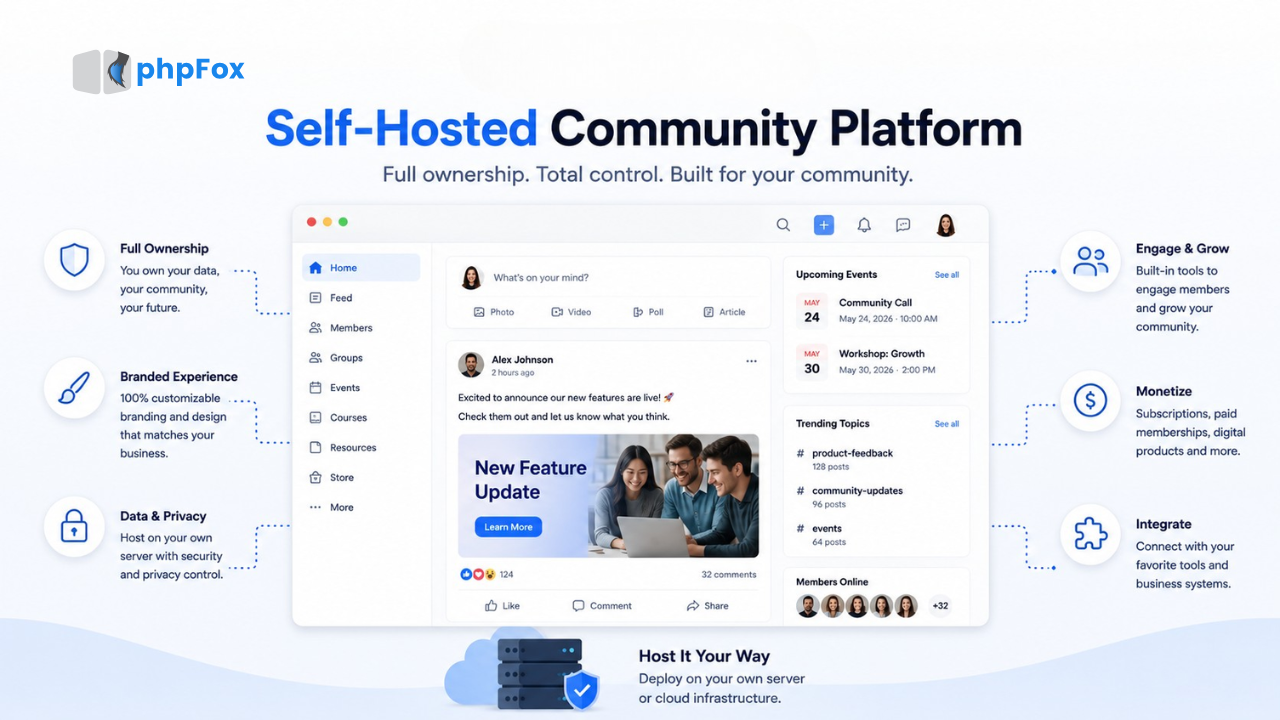
A self-hosted community platform is a type of online community software that gives businesses full ownership and control over
- your customer data
- branding and user experience
- monetization
- integrations
- moderation policies
- platform customization
- community growth strategy
In simple terms, your business owns the platform instead of relying on someone else’s ecosystem. Instead of building your customer community on third-party platforms like Facebook Groups, Discord, or Slack, a self-hosted community platform allows you to run the community under your own brand, domain, infrastructure, and business rules.
This is one of the biggest differences between a self-hosted community platform and traditional social platforms or SaaS platforms. And if you’re still weighing which model fits your business, we broke down the full comparison right here:
An example of a self-hosted community platform is phpFox. Unlike traditional social platforms, where businesses are restricted by platform rules and limited branding control, phpFox allows brands to build a fully independent community platform under their own ecosystem. This means businesses can:
- own their customer data
- customize the user experience
- create membership-based communities
- monetize through subscriptions or digital products
- integrate with existing business tools
- launch native mobile apps
If you want to explore how a self-hosted community platform works in practice, phpFox Free Trial is a good place to start.
2. Why More Brands Are Moving Toward Self-Hosted Community Platform
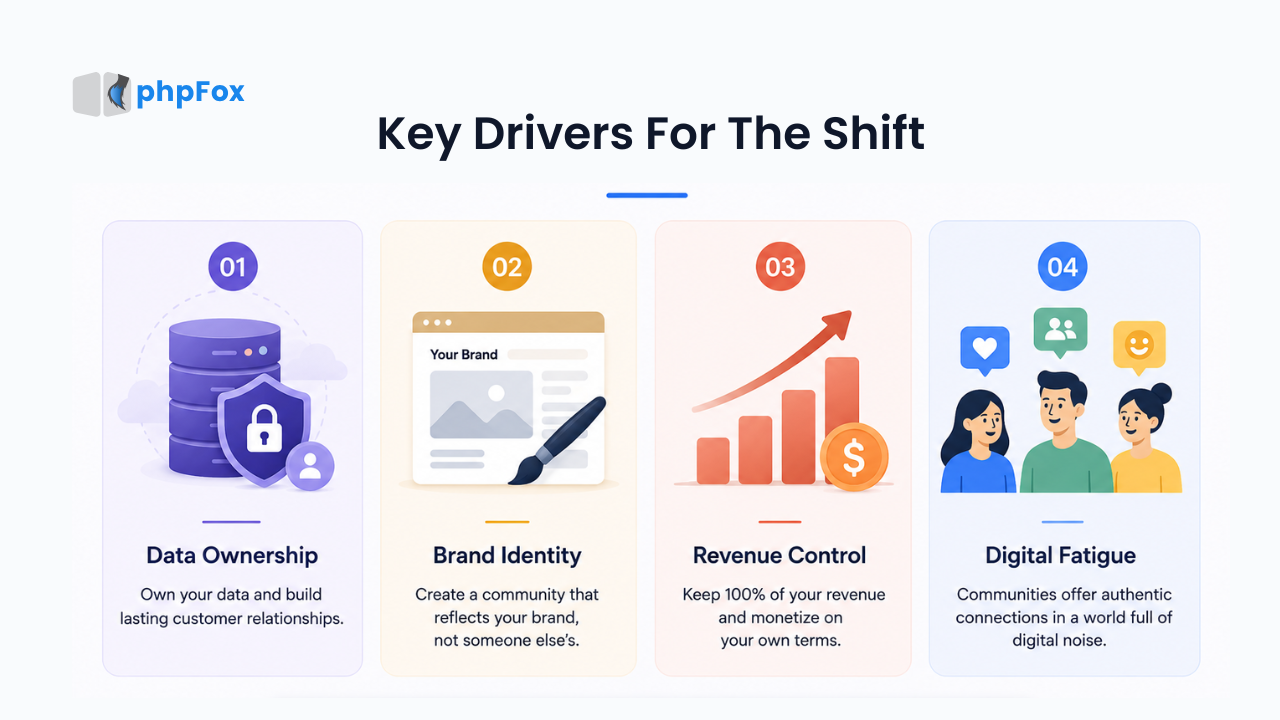
2.1 First-party Data Ownership
One of the biggest advantages of a self-hosted community platform is complete ownership of your customer data.
When brands build communities on third-party platforms like Facebook Groups or Discord, they don’t fully control the audience data, behavioral insights, or long-term access to their members. Platform algorithms decide visibility, engagement reach can fluctuate overnight, and policy changes can directly impact how brands communicate with their own customers.
A self-hosted community platform gives brands stronger first-party data strategies while reducing dependency on external social platforms.
For businesses focused on customer retention and long-term growth, owning the relationship with customers becomes a major strategic advantage.
2.2 No Vendor Lock-In
Another reason many founders are moving toward a self-hosted community platform is the flexibility and independence it provides. Traditional SaaS community tools can be convenient in the early stages, but over time, many businesses run into challenges such as rising subscription costs, feature limitations, restricted customization, and dependency on the vendor’s roadmap.
In some cases, brands outgrow the platform entirely but face difficulties migrating their community elsewhere.
Self-hosted community platforms reduce that risk by giving businesses greater control over their infrastructure, scalability, and long-term platform direction.
2.3 Revenue Control
Most SaaS community platforms take a cut of every transaction — anywhere from 2% to 5% or more. At scale, that adds up to a significant amount of revenue, quietly leaving your business with every payment processed.
With a self-hosted platform, what you charge is what you keep. A self-hosted community platform puts you in full control of how you make money — the models you use, the prices you set, and how much of it you actually keep. You can charge members monthly or annually through subscriptions and membership tiers, gate premium content or digital products behind a paywall, and even run in-app purchases directly inside your branded mobile app.
When you own the platform, you also own the ad inventory — which means you choose which brands get access to your audience and keep 100% of what sponsors pay.
2.4 Deepened Customer Trust
Public social platforms are noisy. Customers are constantly exposed to ads, competing brands, algorithm-driven distractions, and low-quality interactions. That environment makes it harder for brands to create meaningful engagement and authentic relationships. A self-hosted community platform allows businesses to create more curated and intentional customer spaces.
2.5 Enhanced Customization
Every community operates differently. A SaaS customer community has different needs than a creator membership platform, a gaming network, or a professional association. That’s why customization matters so much when choosing a community platform. Self-hosted community platform gives brands significantly more flexibility compared to rigid social networks or closed SaaS tools. Businesses can customize:
- branding and UI
- onboarding flows
- membership systems
- gamification features
- user permissions
- monetization models
- integrations
- workflows
- community structure
This allows brands to build a community experience that aligns closely with their business model and customer journey.
For example, platforms like phpFox allow businesses to create fully branded social communities with features like groups, activity feeds, live streaming, marketplaces, memberships, mobile apps, and advanced customization options — all under their own ecosystem.
That level of flexibility is difficult to achieve on platforms like Facebook Groups or Reddit, where the experience is ultimately controlled by the platform itself.
3. How Does a Self-Hosted Community Platform Increase Customer Retention?
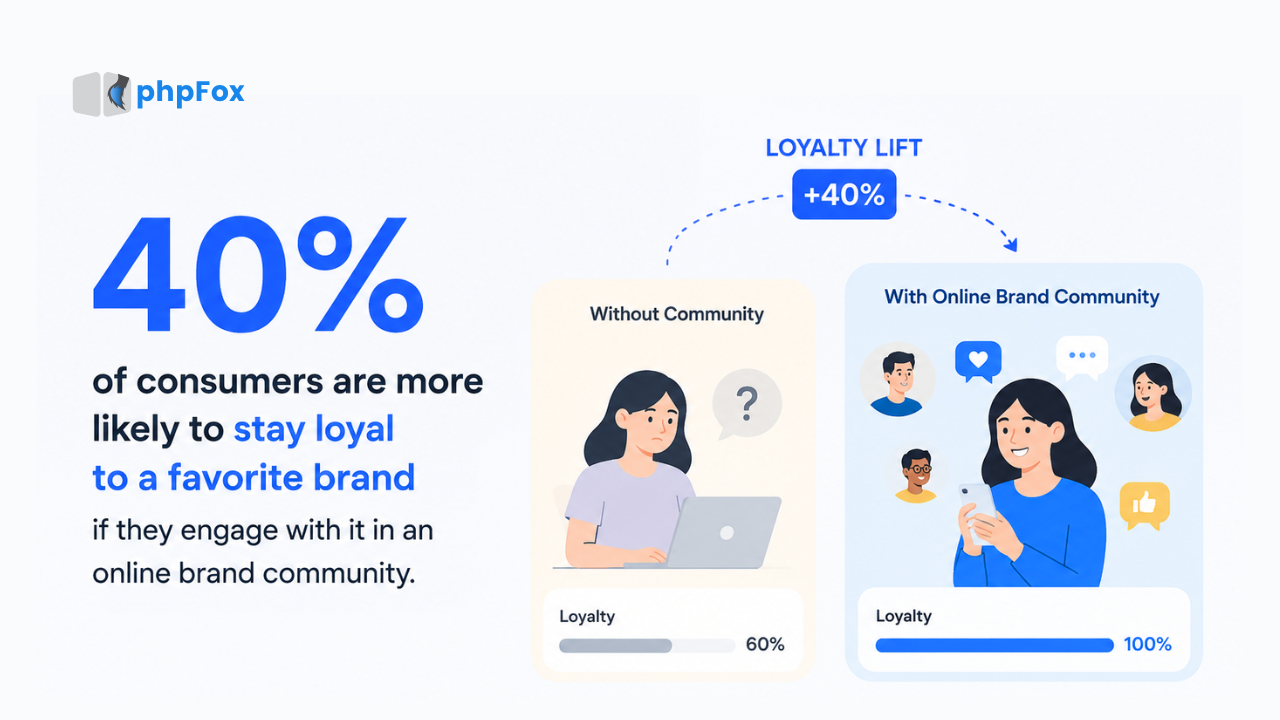
Retention isn’t just about having a good product — it’s about giving customers a reason to stay invested long after the initial purchase. A self-hosted community platform creates that reason by building something no competitor can easily replicate: a community your customers genuinely belong to. Here’s how it works in practice.
3.1 Faster Time-to-Value When new members join your self-hosted community platform, they don’t have to wait in a support queue to figure things out. Experienced peers are already there — answering questions, sharing workflows, and helping newcomers get results faster. The quicker someone sees value, the less likely they are to churn.
3.2 Relational Switching Costs This is one of the most underrated retention mechanics a self-hosted community platform creates. When customers build real relationships, earn reputational status, and accumulate knowledge within your community — leaving your product means losing all of that too. That’s a switching cost no pricing strategy alone can overcome.
3.3 Reduced Support Friction Your community becomes an always-on self-service hub. Members search existing threads, ask peers, and solve problems without ever touching your support queue. Less frustration for customers, less pressure on your team — and a community that gets more valuable the more it grows.
3.4 Continuous Product Feedback Owning your platform means you’re capturing the voice of your customer in real time — not through exhausting surveys, but through natural conversations happening inside your community every day. You can test features with dedicated user groups, close the feedback loop faster, and make members feel genuinely heard in the process. Industry research consistently shows that strong community engagement improves customer loyalty, reduces churn, and increases renewal rates. Engaged community members are 3x less likely to churn according to Circle, while Adobe found that customers participating in its community were 4x more likely to renew subscriptions.
4. Who Should Use a Self-Hosted Community Platform?
Not every business needs a self-hosted community platform. But for brands focused on customer retention, audience ownership, and long-term engagement, owning the community experience can become a major competitive advantage.
Here are the types of businesses that benefit most from building a self-hosted online community platform.
4.1 SaaS & Software Companies: When your product has a learning curve, community becomes your best retention tool. A self-hosted platform gives your users a place to ask questions, share workflows, request features, and help each other succeed — reducing churn while simultaneously generating the kind of peer-to-peer advocacy that no marketing budget can buy.
4.2 Membership & Subscription Businesses If recurring revenue is your model, community is what keeps people subscribed. A self-hosted community platform lets you build real relationships between members, create exclusive access tiers, and give subscribers a reason to stay that goes beyond the content itself. When leaving means losing the community, retention takes care of itself.
4.3 Online Educators & Course Creators: Courses alone don’t create loyalty — community does. Educators who build a self-hosted platform around their content give students a place to connect, collaborate, and continue learning long after a course ends. That ongoing engagement turns one-time buyers into long-term members.
4.4 Wellness & Lifestyle Brands For brands built around personal transformation — fitness, mental health, nutrition, personal development — community is the product. People don’t just want information. They want accountability, encouragement, and connection with others on the same journey. A self-hosted platform gives you full control over that experience without the noise and distraction of social media.
4.5 Professional Networks & Associations Organizations that connect professionals around a shared industry, skill set, or mission benefit enormously from owning their community infrastructure. A self-hosted platform lets you manage member roles, moderate discussions, host events, and build a structured networking environment that reflects the professionalism of your brand.
4.6 Niche Communities & Creator Networks The more specific your audience, the more valuable your community becomes. A self-hosted platform lets niche creators and community builders own their audience completely — no algorithm filtering who sees what, no platform deciding how you can monetize, no risk of losing everything to a policy change.
4.7 Enterprises & Large Brands For enterprise businesses managing large customer bases, a self-hosted community platform provides the scalability, security, and customization that SaaS tools simply can’t match. Full data ownership, API flexibility, custom member roles, and enterprise-level moderation are non-negotiable at this scale — and they require a platform you control end to end. If your business falls into any of these categories, the question isn’t really whether a self-hosted community platform makes sense. It’s how much longer you can afford to build without one.
Final Thoughts
Building a self-hosted community platform isn’t the easiest path — and it’s not meant to be. It requires real investment, thoughtful setup, and a clear vision for what you’re building. But for the businesses that are ready for it, the return goes far beyond engagement metrics and member counts.
When you own your platform, you own the relationship. Your data, your brand, your revenue model, your member experience — none of it is subject to someone else’s algorithm update, pricing change, or policy decision. That independence compounds over time in ways that rented platforms simply can’t replicate.
The brands winning at community in 2026 aren’t the ones with the biggest social media following. They’re the ones who made the decision early to stop building on borrowed land — and started investing in something they actually own.
Platforms like phpFox are helping businesses build fully branded customer ecosystems with complete ownership, flexible customization, monetization tools, native mobile apps, and scalable social networking features.
If your business is exploring how to build a self-hosted community platform focused on customer retention and long-term audience ownership, you can explore the phpFox Free Trial to see how the platform works in practice.