
In 2026, the online community platform is no longer just a marketing channel. For many businesses, it’s part of the product and retention strategy. That’s why more companies are investing in online community platforms for brands that give them greater control over branding, member experience, engagement, and data ownership.
The best online community platforms for brands aren’t simply the ones with the most features. It’s the one that aligns with your long-term business goal — whether you’re building a paid membership community, a customer community, or a fully branded social network.
In this guide, we’ll compare the best online community platforms in 2026 based on what actually matters for modern brands, such as white-label branding, mobile app experience, and monetization flexibility. We’ll also break down where platforms like phpFox, Circle, Mighty Networks, BuddyBoss, Bettermode, Facebook Groups, and Discourse fit best, depending on your business goals.
1. Why an Online Community Platform for Brands Matters in 2026
Before diving into platform options, let’s start with the basics.
An online community is a dedicated space where people with shared interests, goals, or challenges come together to connect, learn, and support each other — under a brand they trust. For businesses, it’s where your audience stops being a following and starts becoming something that actually belongs to you.
And if you want to know everything about building, growing, and owning one — we’ve put together a complete guide right here:
Here’s what’s actually shifted in 2026: people are tired of scrolling. They’re tired of passive feeds, algorithm-driven content, and interactions that feel transactional. What they’re looking for — and what your brand can give them — is something more direct, more human, and more intentional. That’s the gap online community platforms for brands are filling right now, and why more businesses are treating community as core infrastructure rather than a nice-to-have marketing add-on.
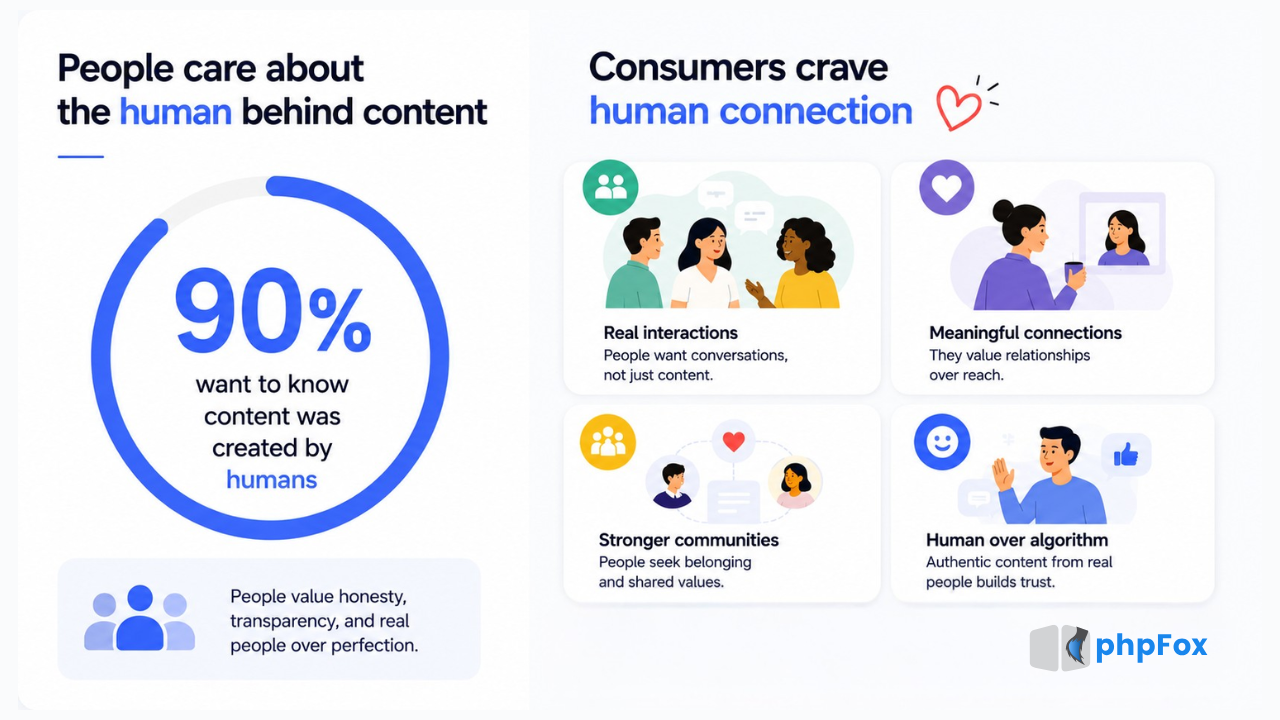
Research found that 90% of consumers care whether content is created by real people, while younger audiences are shifting toward community-first platforms and more meaningful engagement. (Source: iHeartMedia)
When you own your community platform, you own the relationship. You collect first-party customer data directly — no third-party tracking, no algorithm deciding what you can see or who sees you. You gather real feedback from real members. You turn casual buyers into long-term brand advocates who keep coming back — not because of a retargeting ad, but because they genuinely belong somewhere.
That’s a fundamentally different kind of loyalty. And it doesn’t depend on ad spend or algorithm changes to sustain it.
As your community grows, the foundation matters more and more. You need proper member management, monetization tools, a branded mobile app, deep engagement features, and full ownership of your customer data. The right online community platform for your brand gives you all of that — on your terms, under your brand, with no ceiling on where it goes.
Because if you’re relying entirely on a third-party platform to deliver that experience, you’ll always be playing by someone else’s rules.
2. Key Considerations for Brands
Picking a community platform isn’t just a software decision — it’s a business decision that will follow you for years.
Get it right, and your community becomes one of the most valuable assets your brand owns. Get it wrong, and you’re either stuck on a platform that can’t grow with you or you’re rebuilding everything from scratch at the worst possible time.
Here’s what actually separates a good platform from the right one.
2.1. White-Labeling
The moment a member sees another platform’s logo on your community, the trust you’ve built takes a hit. It signals that you don’t fully own the space — and frankly, you don’t.
A proper white-label community platform lets you strip out all third-party branding and replace it with your own — your domain, your logo, your design, your mobile app. What members experience should feel like your product, not a template someone else built.
For wellness brands, coaching businesses, membership platforms, and professional communities, this isn’t a nice-to-have. It’s the difference between being seen as a serious brand and looking like you’re still figuring things out.
2.2 Integrations
Online community platforms for brands that don’t talk to the rest of your business are just a group chat.
As you grow, you’ll need your platform to connect with the tools you’re already using — your CRM, email marketing, payment gateways, analytics, automation workflows, customer support systems, and learning management tools. Without these connections, your team ends up juggling disconnected data, duplicated work, and workflows that don’t make sense.
For SaaS companies, membership businesses, and any brand using community as part of their customer journey, integration capability isn’t optional. It’s what turns a community into an actual business engine.
2.3. Data Ownership
This one hits hardest for brands that have spent years growing a Facebook Group or Discord server — and then realized they don’t actually own any of it.
The platform does. They control the algorithm, the visibility, the data, and the rules. And they can change all of it overnight without asking for your permission.
When you own your platform, you own everything that lives inside it — your member data, your relationships, your content, your community history. That’s what makes it a real business asset instead of a following you’re renting from someone else.
For brands thinking long-term, this is often the single most important factor in the decision.
2.4. Monetization
Too many community platforms make monetization an afterthought — a clunky add-on that barely works and takes a cut of everything you earn.
The right platform should support the way you want to make money: memberships, subscriptions, paid content, digital products, live events, creator programs, and advertising. And it should do that without restrictive platform rules or revenue-sharing structures that eat into your margins.
Before you commit to any platform, stop asking “can this host a community?” Start asking: “Can this support my business model two years from now?”
2.5. Scalability
Most brands outgrow their first platform faster than they expect.
What works fine for a community of 500 members starts to crack under the weight of 50,000. You hit feature limits, customization walls, performance issues, and pricing tiers that suddenly make the “affordable” option look very expensive.
Migrating a community isn’t just technically difficult — it’s disruptive to the members who’ve built habits and relationships inside your platform. The smartest move is to choose something that can scale from the beginning, so growth never becomes a reason to start over.
3. Top 7 best online community platforms for brands
Now, let’s compare the best online community platforms for brands out there.
1. phpFox — Best for Brands That Want Full Ownership & a True Social Network Experience
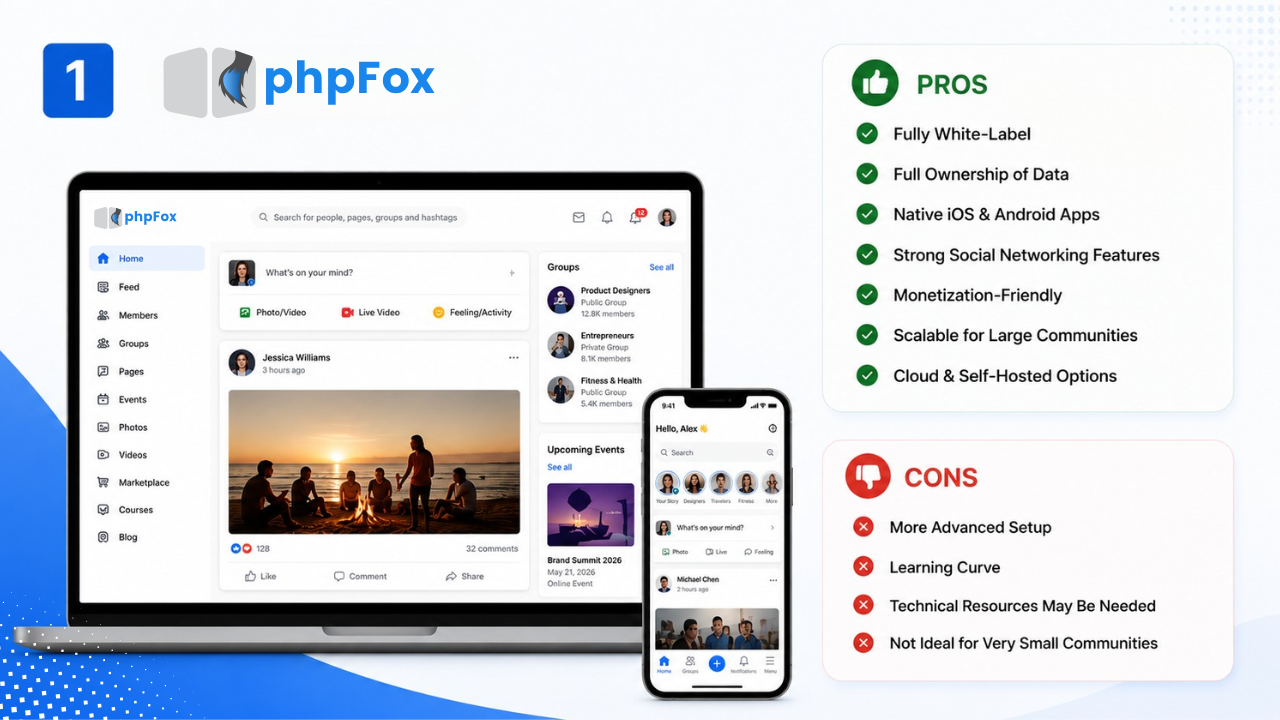
phpFox has been in the community platform space for over a decade — and the users who’ve stayed longest will tell you the same thing: once you find the right foundation, you don’t leave.
With most SaaS tools, you’re operating inside someone else’s ecosystem — their rules, their infrastructure, their data policies. phpFox flips that entirely. As one of the best online community platforms for brands, it gives you a fully independent, fully branded space built around your business model, not theirs.
The feature set out of the box is also a consistent strength — marketplace, blogs, forums, photos, groups, polls, quizzes, and more — covering everything you’d expect from a full social networking platform without needing to stitch tools together. It’s why phpFox tends to attract brands that are serious about the long game — businesses that see community not as a marketing channel, but as a core business asset.
Pros
- Fully white-label — your brand, your domain, your app
- 100% ownership of audience and data
- Deep customization without a dev team for every change
- Native iOS & Android apps included
- Built-in monetization: subscriptions, memberships, paid content
- Scales from small communities to hundreds of thousands of members
- Available as cloud-hosted or self-hosted
Cons
- Setup has a learning curve compared to plug-and-play SaaS tools
- The depth of customization may be more than very early-stage creators need right away
- Version upgrades can be cumbersome — especially with custom development on older versions
- Support slows on weekends and holidays
Best For: Businesses, niche social networks, creators, educators, and organizations that want a fully owned, fully branded community platform with social networking depth
Not ideal for: Non-technical users looking for a zero-setup SaaS experience, or a very small community If you’re looking for the best online community platforms for brands that you can own, grow, and monetize completely on your own terms, phpFox is built for exactly that.
2. Mighty Networks — Best All-in-One Platform for Creators
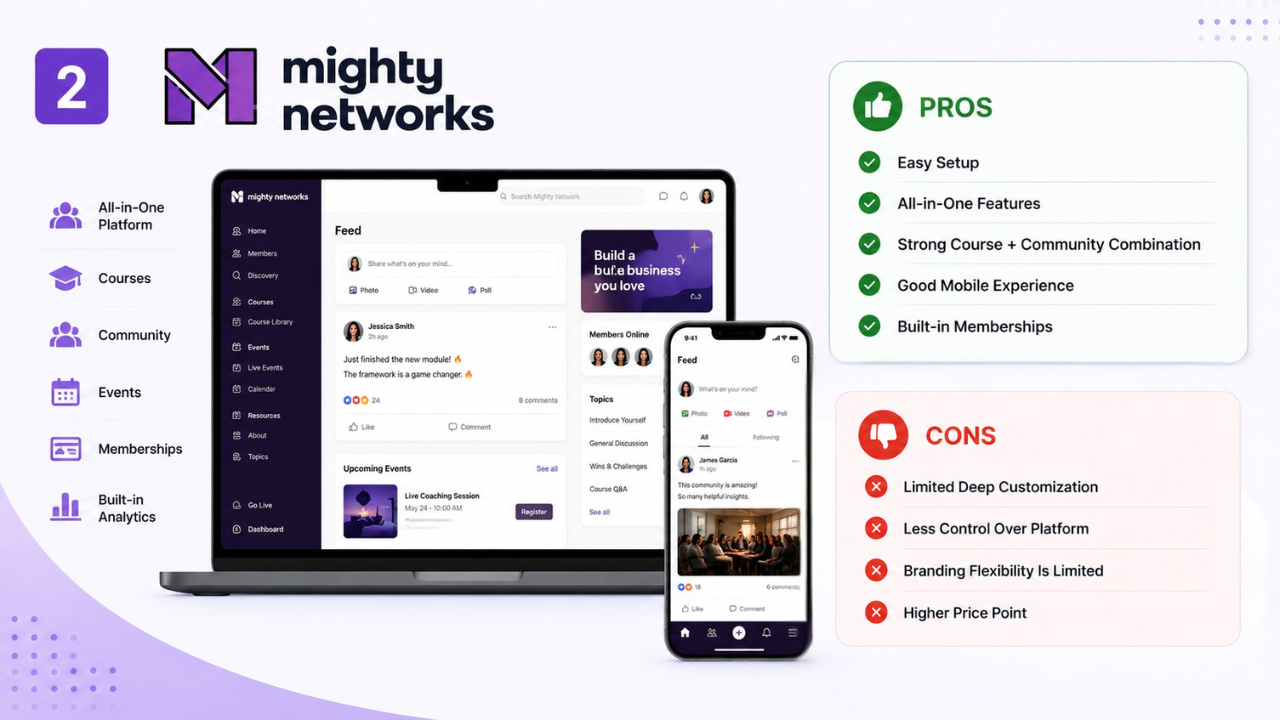
Mighty Networks has become one of the most recognized platforms in the creator economy space. It combines community features with online courses, memberships, and events inside a polished user experience designed primarily for creators, coaches, and educators. The platform is relatively easy to launch and works well for businesses that prioritize speed and simplicity over deep customization. Mighty Networks performs particularly well for:
- coaching businesses
- course creators
- creator memberships
- personal brands
- online educators
Not ideal for: Brands that need full data ownership, advanced member management, deep SEO control, or a platform that can scale into a large-scale branded social ecosystem.
3. Circle — Best for Creators & Membership Communities That Want Fast Setup
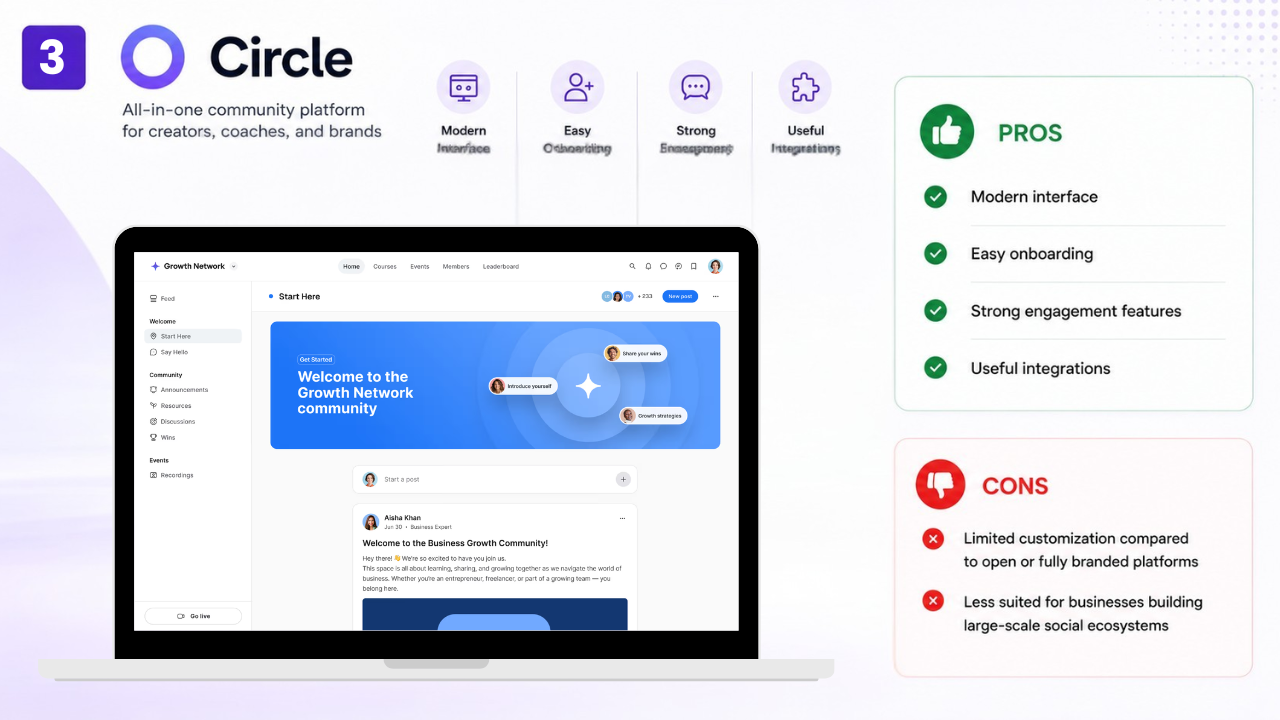
Circle has built a strong reputation for a reason — it’s genuinely one of the most polished online community platforms for brands on the market. It focuses heavily on discussion-based communities, memberships, and engagement features while keeping the platform relatively simple to manage. Circle has become especially popular among:
- premium membership communities
- creator communities
- startup founders
- business networks
The platform is intuitive and polished, making onboarding easier for both admins and members. However, customization is where Circle most often falls short. Users regularly cite limited options for changing how things look or organizing content exactly the way they want — particularly for course management, landing pages, and space-level settings.
Pros
- Clean, modern interface that’s easy for both admins and members
- Fast onboarding — communities can launch in under a week
- Strong all-in-one experience: courses, events, discussions, and monetization
- Regular feature updates and a product team that ships consistently
- AI support tool that can actually adjust settings on your behalf
Cons
- Limited customization — layout, course structure, and space settings are constrained
- No budget-friendly entry plan — expensive to test before committing
- Pricing scales quickly and some basic features cost extra at higher tiers
- Less suited for brands needing deep branding control or large-scale social ecosystems
Best For: Creators, coaches, and membership communities that want a polished, fast-to-launch platform and don’t need deep customization or full data ownership.
Not ideal for: Brands that need white-label control, flexible monetization structures, or a platform that scales beyond the creator economy into enterprise or large-scale social networking.
4. BuddyBoss — Best WordPress-Based Community Builder
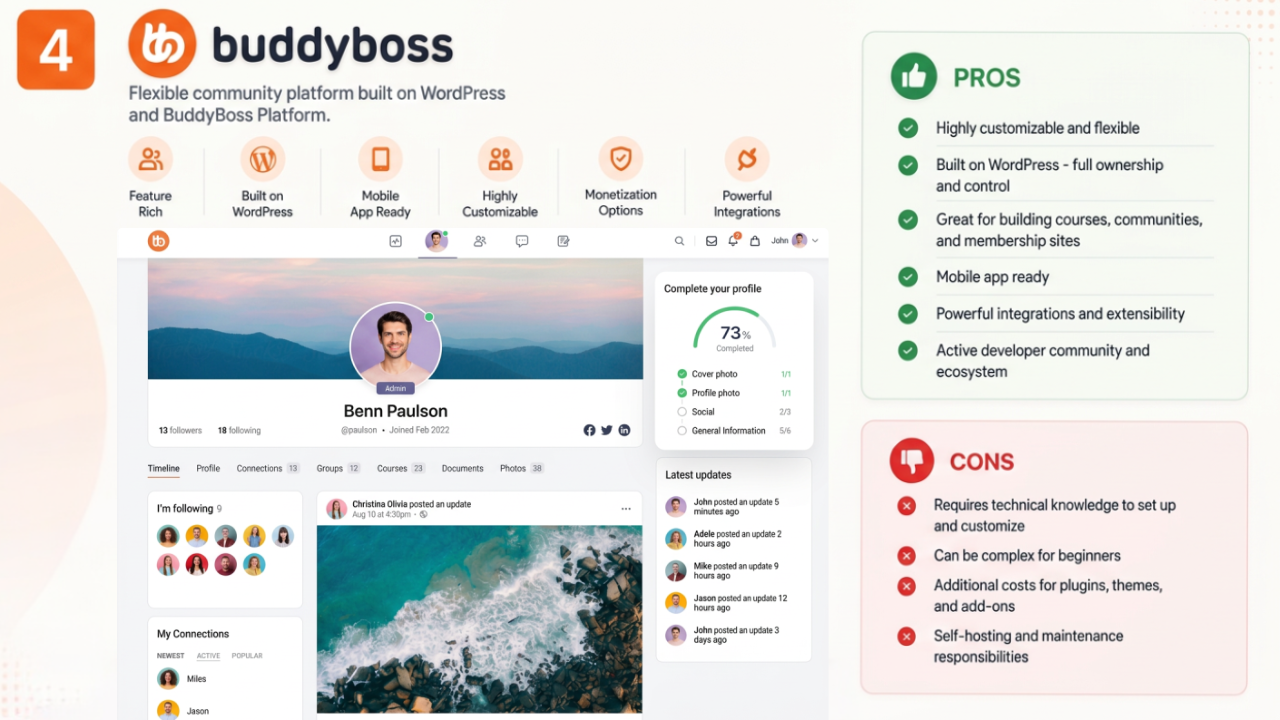
If your website is already built on WordPress, BuddyBoss will feel like a natural extension of what you already have — and that’s genuinely one of its biggest strengths. Built on top of WordPress and BuddyPress, BuddyBoss gives businesses a feature-rich community layer without having to migrate their entire infrastructure. For course creators and educators in particular, the deep LMS integration — especially with LearnDash — and the white-label mobile app have saved users thousands in development costs. That’s a real advantage for businesses that want full ownership without rebuilding from scratch. Pros
- Natural fit for businesses already running on WordPress
- Deep LMS integration — ideal for course creators and online educators
- Fully white-label mobile app for iOS and Android
- Strong customization flexibility within the WordPress ecosystem
- Feature-rich community tools: groups, forums, activity feeds, messaging, gamification
- Responsive support team with an active user community
Cons
- Plugin compatibility issues are a recurring problem — updates can break integrations
- Renewal pricing is not transparent upfront — long-term costs can surprise new users
- Basic branding controls are tied to an active license, even when no support is needed
- Setup requires technical knowledge — not beginner-friendly without a developer
Best For: WordPress-based businesses, course creators, membership sites, and educators who want full ownership and deep LMS integration within the WordPress ecosystem.
Not ideal for: Businesses without WordPress infrastructure, non-technical teams looking for a quick setup, or brands that need a self-contained platform independent of WordPress’s ecosystem complexity.
5. Bettermode — Best for SaaS & Software Companies
Bettermode (formerly Tribe) carved out a clear niche in the online community platforms for brand space — and for the right use case, it does that job well. For SaaS businesses in particular, Bettermode’s flexible space structure works well for combining product feedback, feature requests, forums, and direct communication between users and product teams — all within a single platform.
Migration support is another genuine strength. Users who moved from other platforms describe the process as fast and well-supported, with the right tools and a responsive team to handle issues along the way. Bettermode works well when your primary goal is structured customer engagement. When you need social depth, full branding control, or serious monetization, it starts to show its limits.
Pros
- Clean, modern UI that feels familiar to users
- Fast setup — communities can be configured within days
- Flexible space structure ideal for product feedback, forums, and knowledge bases
- Good integrations with SaaS tools and workflows
- Scalable community management without relying on developers
Cons
- Support response times can be slow — critical issues have taken weeks to resolve
- White-labeling and key features require paid add-ons on top of the base subscription
- Limited built-in monetization — no native subscription management
- No backend access, which limits SEO control and technical customization
- Less suited for social-style communities or brands needing deep branding flexibility
Best For: SaaS companies and software businesses looking to centralize customer onboarding, product feedback, knowledge bases, and community engagement in one structured platform.
Not ideal for: Brands that need full data ownership, deep social networking features, robust monetization tools, or a platform where support response time is critical to operations.
6. Facebook Groups — Best for Growing Audience Organically
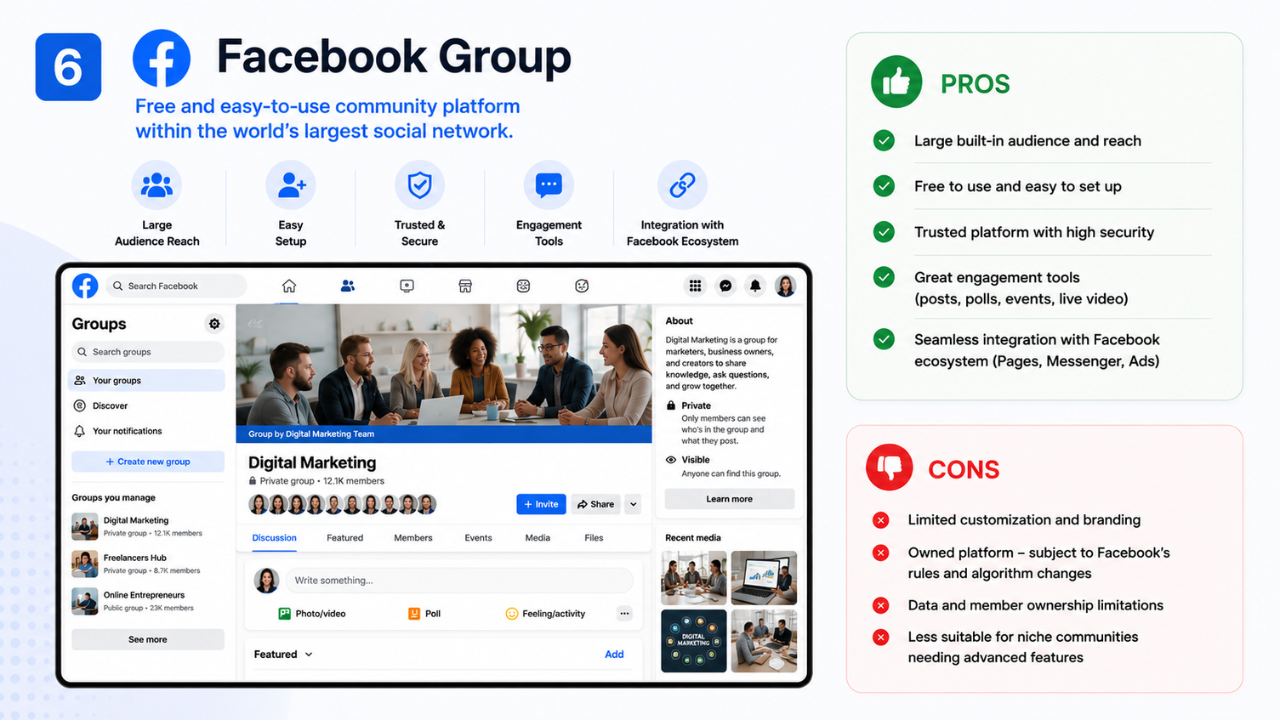
Facebook Groups remain one of the easiest ways to grow an audience quickly because of Facebook’s massive built-in user base. It’s free, nearly 1.8 billion people use Facebook Groups every month, and your audience is probably already there. For getting something off the ground quickly with zero budget, it’s hard to argue against it. For early-stage communities, the low barrier to entry can be valuable. However, many brands eventually encounter limitations as communities scale. Common pain points include:
- declining organic reach
- algorithm dependency
- limited branding
- distractions from ads and unrelated content
- lack of ownership over member data
As a result, many businesses now use Facebook Groups primarily as a top-of-funnel audience acquisition channel while moving their most engaged members into owned community platforms later.
Pros
- Free to use — zero platform cost to get started
- Massive existing user base — your audience is already there
- Zero onboarding friction for members
- Higher organic reach than Facebook Pages
- Easy to set up and manage at a basic level
Cons
- You own nothing — not your data, not your member list, not your community
- Algorithm controls who sees your content — not you
- Members are constantly distracted by ads and unrelated content
- No branding control — everything lives under Facebook’s identity
- No monetization tools beyond basic paid subscriptions
- Zero customization of the member experience
- An account or group can be restricted or removed at any time
- No dedicated mobile app for your brand
Best For: Early-stage communities testing an idea with zero budget, or brands using Facebook Groups as a top-of-funnel channel to attract members before moving them to an owned platform.
Not ideal for: Any brand serious about data ownership, long-term community building, monetization, or creating a premium branded experience that reflects their identity.
7. Discourse — Best Open-Source Forum for Developer & Technical Communities
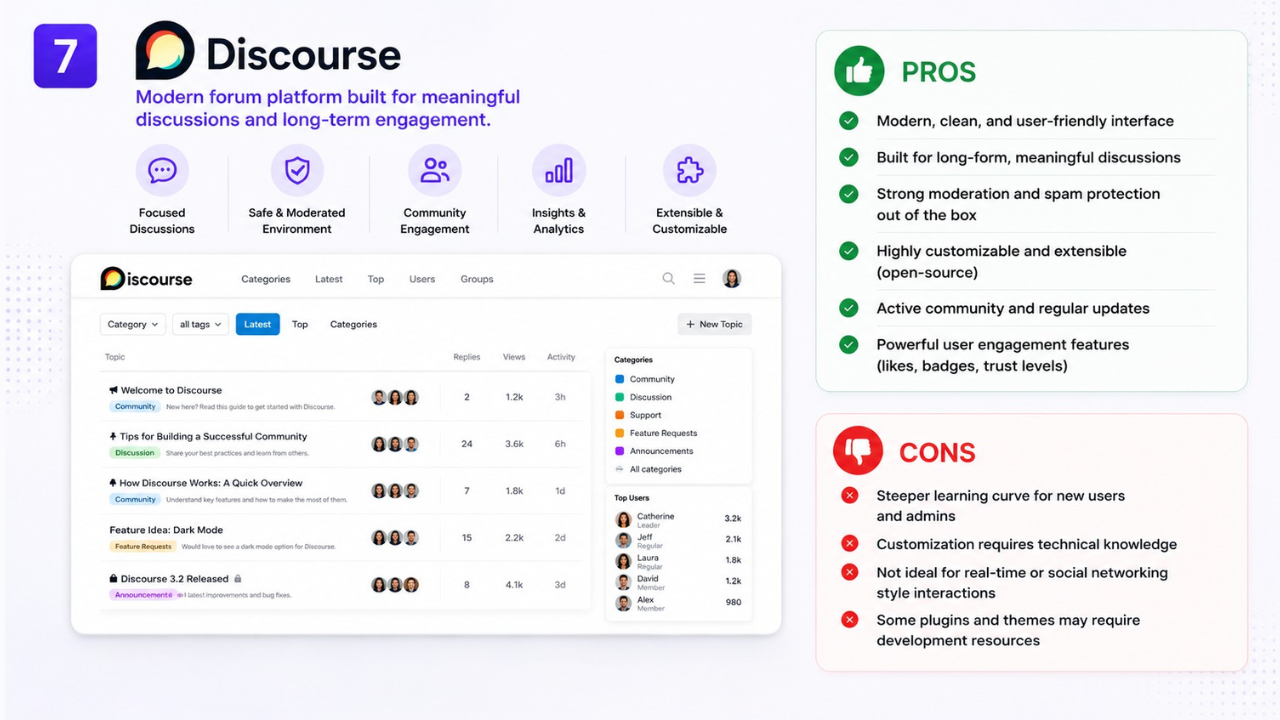
Discourse has become the go-to choice for developer ecosystems, open-source projects, and technical communities that need serious discussion infrastructure. Discourse is also widely considered excellent for SEO — forum threads create thousands of pages of keyword-rich content that rank on Google, which means your community’s knowledge base actively drives organic traffic over time. That’s an advantage that most modern online community platforms for brands simply don’t offer.
From a technical perspective, Discourse supports plugins, themes, and a RESTful API — enabling deep customization and integrations without modifying the core system. For engineering teams that want to build something tailored, that flexibility is a genuine differentiator.
However, navigation can be non-intuitive — especially for non-technical users who don’t have a forum background. And for brands expecting the social networking depth of activity feeds, member profiles, stories, or live streaming, Discourse simply isn’t built for that.
Pros
- Gold standard open-source forum software — trusted by major developer communities worldwide
- Sophisticated trust and moderation system that maintains discussion quality automatically
- Excellent SEO performance — forum content ranks on Google and drives organic traffic
- Deep customization via plugins, themes, and REST API
- Self-hosted option gives full data ownership and control
- Real-time chat combined with long-form discussion in one platform
- Strong multilingual support and accessibility compliance
Cons
- Forum-centric experience — not suited for social networking or creator communities
- Navigation can feel non-intuitive for non-technical or casual users
- Requires technical setup and server knowledge for self-hosted deployment
- Limited social features out of the box — no activity feeds, stories, or mobile app
- Not the right fit when used as a real-time communication replacement for tools like Slack
Best For: Developer communities, open-source projects, technical forums, and organizations that need a structured, SEO-friendly discussion platform with full data control.
Not ideal for: Brands looking for a social networking experience, non-technical teams without developer support, or communities that need mobile apps, monetization tools, or rich engagement features beyond discussion threads.
Final Thoughts
Every platform on this list has something to offer — but the right online community platforms for brands come down to one question: what kind of community do you actually want to build, and who do you want to own it?
If full ownership is what you’re after — your data, your brand, your revenue, your rules — phpFox is the clear top pick. It’s the only platform on this list that gives you a complete social networking experience on infrastructure you fully control. No algorithm decides your reach. No platform is taking a cut of your revenue. No risk of waking up one day to find the rules have changed. For businesses serious about building a community as a long-term asset, phpFox is where that starts.
If you’re a creator or membership business looking for a polished, all-in-one experience without the technical overhead, Mighty Networks is a strong second choice. It strikes a good balance between features, engagement tools, and ease of use — and it’s priced reasonably for what you get.
For communities that prioritize a modern, clean interface and fast time-to-launch, Circle rounds out the top three. It’s particularly well-suited for course creators, coaches, and membership communities that want everything in one place and don’t need deep branding control.
The bottom line is simple: if you’re building something you plan to grow and monetize for years, don’t build it on borrowed land. Start with a platform you own.
We hope this guide helped you cut through the noise. If you have questions about which platform fits your specific use case, drop them in the comments below — we’re happy to help you figure it out.
Frequently Asked Questions
[faq_accordion]
1. How are online community platforms for brands different from a social media group?
With a social media group, you’re building on someone else’s platform — their algorithm controls your reach, their policies can change overnight, and your member data belongs to them. An online community platform gives you your own space: your brand, your data, your rules. It’s the difference between renting and owning.
2. How much does it cost to build online community platforms for brands?
Costs vary widely depending on the platform and approach. SaaS tools like Circle and Mighty Networks typically charge monthly fees that scale with your member count. Self-hosted platforms like phpFox require a higher upfront investment but give you more control and lower long-term costs as your community grows. Hidden costs — add-ons, transaction fees, and migration — are worth factoring in before you commit.
3. Which platform is best if I want to monetize my community?
phpFox offers the most flexibility — subscriptions, memberships, paid content, in-app purchases, and advertising, without revenue-sharing restrictions. Circle and Mighty Networks support monetization too, but with more limitations on pricing structures and what you can charge for.
4. Can I migrate my existing community to a new platform?
Yes — and many brands do exactly this as they outgrow their current setup. The process involves exporting whatever data you can, setting up your new platform, and gradually transitioning your members over. The earlier you make the move, the less disruption it causes — and the sooner you start building on a foundation you actually own.
[/faq_accordion]