Choosing the right online community software is one of the most important decisions you’ll make for your brand, business, or organization in 2026.
Get it right, and your community becomes a long-term business asset — a space where members engage, connect, and return on their own. Get it wrong, and you’re either fighting your tools, rebuilding from scratch, or watching members drift away to competitors. The market for community management software has matured significantly.
There are now platforms built for associations, businesses, creators, enterprises, and niche communities — each with a different philosophy on what an online community should be and how it should work.
This guide breaks down the nine best online community software available in 2026, organized by who they’re built for, so you can find the right fit for your goals without wading through platforms that were never designed for you. Before we dive in, it’s worth clarifying what to look for — because not all community platforms are evaluated the same way.
The Basics of Online Community Software
Before comparing different platforms, it’s important to understand what online community software actually is, why organizations invest in it, and what benefits it can bring to your members, customers, or audience. Whether you’re building a customer community, a professional network, a membership site, or a niche social platform, having a strong foundation will help you choose the right solution for your goals.
What Is Online Community Software?
Online community software empowers businesses, organizations, niche community builders, and creators to build fully independent, private online communities where members can connect, share content, participate in discussions, and engage with one another around common interests. If you’d like a deeper look at how online communities work and why they’re becoming increasingly valuable for businesses and niche creators alike, check out our blog below:
Why Do Organizations Need Online Community Software?

Today’s audiences have more content competing for their attention than ever before. Between social media feeds, email newsletters, podcasts, AI-generated content, and online events, it has become increasingly difficult for organizations to build meaningful, long-term engagement. That’s where online communities create a unique advantage. Rather than broadcasting information to an audience, a community platform allows organizations to facilitate conversations between members. Instead of one-way communication, communities create opportunities for collaboration, networking, learning, and relationship building. For members, an online community becomes a trusted place to:
- Ask questions
- Share experiences
- Discover valuable resources
- Learn from peers
- Build professional relationships
- Celebrate milestones and achievements
For organizations, community management software creates an entirely new channel for engagement and insight. By observing discussions and interactions, organizations gain a deeper understanding of their audience’s needs, challenges, and interests. This information often proves far more valuable than traditional surveys or analytics reports because it comes directly from real conversations. In an era where trust is increasingly difficult to earn, a thriving online community can become one of an organization’s most valuable assets.
Types of Online Community Software
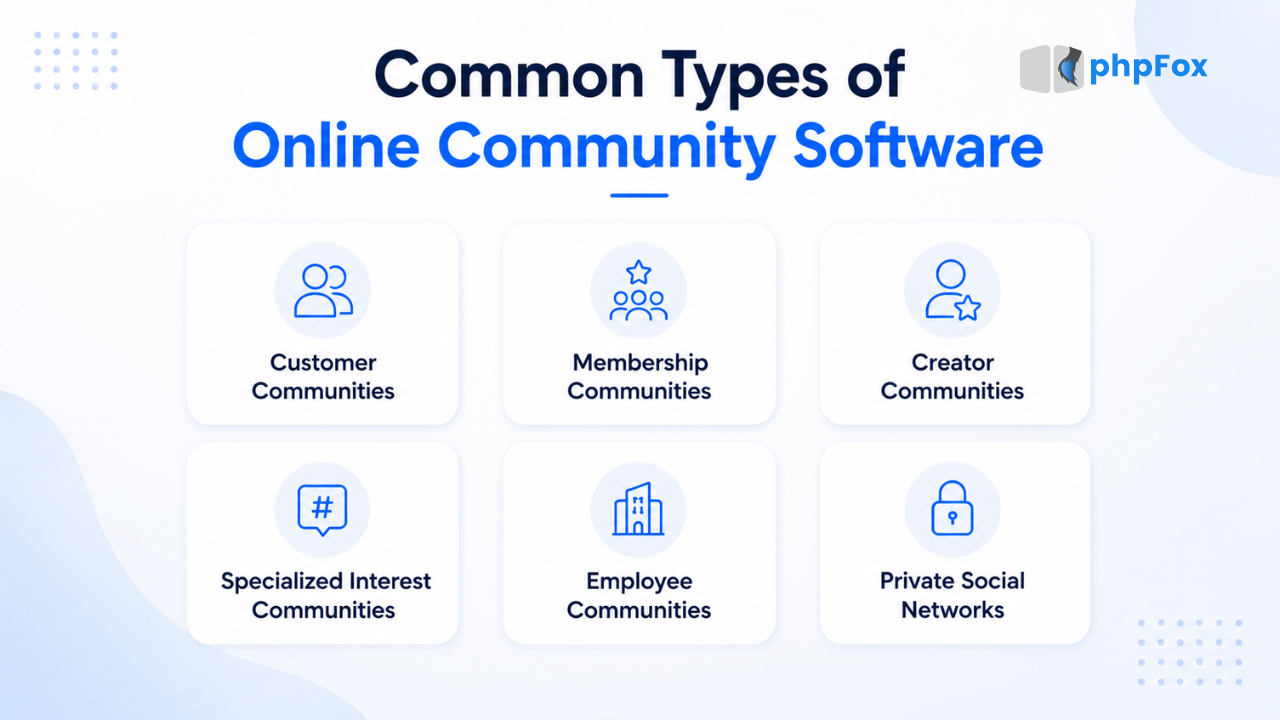
Not every online community serves the same purpose. Before evaluating online community software platforms, it’s helpful to understand which type of community best aligns with your goals. Some of the most common community models include:
- Customer Communities: Customer communities help users connect with one another, share best practices, find support, and provide product feedback. Many SaaS companies and technology brands use customer communities to improve retention, reduce support costs, and strengthen customer loyalty.
- Membership Communities: Associations, nonprofits, and professional organizations often use community platforms to provide year-round value to members through networking, discussions, events, and exclusive resources.
- Creator Communities: Content creators, coaches, educators, and influencers increasingly use community-building platforms to engage their audiences outside traditional social media channels. These communities often combine content, courses, memberships, and networking opportunities.
- Specialized Interest Communities: Some organizations serve highly specific audiences that may not fit comfortably within mainstream social media platforms.
-
Employee Communities: Internal communities help organizations improve communication, collaboration, and knowledge sharing among employees. They are especially valuable for distributed and remote teams.
- Private Social Networks: Some organizations want to build a fully branded social experience where members can create profiles, share content, join groups, and interact within an independent ecosystem.
These communities often require greater control over moderation policies, member privacy, content ownership, and branding than traditional social media can provide.
Examples include communities centered around unique lifestyles, professional affiliations, cultural interests, advocacy groups, private memberships, or other specialized topics where maintaining an independent environment is important. For these organizations, dedicated online community software provides the flexibility to create customized member experiences while maintaining full control over community guidelines, engagement strategies, and audience data..
Benefits of Using Online Community Software
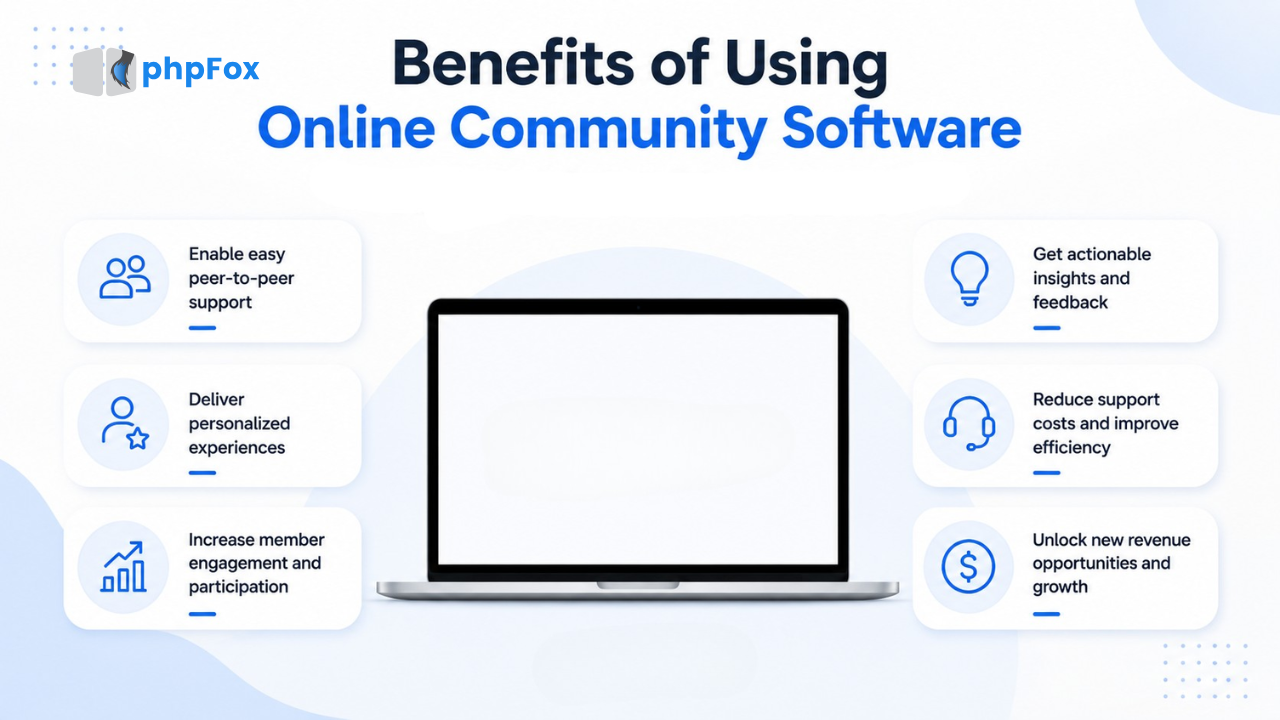
Building a successful community from scratch requires significant development resources, technical expertise, and ongoing maintenance. For most organizations, investing in dedicated online community software is a faster, more scalable, and more cost-effective approach. The right community platform helps organizations create engaging member experiences while simplifying community management. Some of the biggest benefits include:
Boost Engagement and Participation
One of the biggest advantages of online community software is the ability to keep members engaged between major touchpoints. Rather than waiting for the next webinar, conference, course, or email campaign, members can participate in ongoing conversations whenever they choose. This continuous engagement helps strengthen relationships and increase overall community activity.
Gather Valuable Feedback and Insights
Communities create a natural environment for feedback. By monitoring discussions, feature requests, and member interactions, organizations can identify emerging trends, understand audience needs, and uncover opportunities for improvement. Many businesses use their community platform as a direct source of customer insights and product feedback.
Encourage Peer-to-Peer Support
One of the most powerful aspects of community building is enabling members to help one another. Whether users are answering questions, sharing expertise, or recommending resources, peer-to-peer support creates value that benefits the entire community. For businesses, this often translates into reduced support costs and faster problem resolution.
Deliver More Personalized Experiences
Modern community management software often includes tools for personalization. Organizations can recommend relevant content, suggest discussions, create segmented member experiences, and deliver more targeted communications based on member interests and behavior. This helps communities feel more relevant and engaging for every participant.
Strengthen Brand Advocacy
Highly engaged members often become your strongest advocates. They share experiences, recommend your brand, invite others to join, and contribute valuable user-generated content. Over time, a thriving online community can become one of the most effective channels for organic growth and word-of-mouth marketing.
Create New Revenue Opportunities
Many online community platforms now support monetization through memberships, subscriptions, premium content, online courses, virtual events, digital products, and marketplaces. As a result, communities can become more than engagement hubs—they can become sustainable business assets that support long-term growth.
What to Look for in an Online Community Software
There are hundreds of online community software options on the market. The best choice depends on your goals, your audience, and how you plan to grow. But across the board, the strongest platforms share a few key qualities:
Ownership and data control: When you build a community, you should own what you build — your member data, your content, your relationships. Platforms that limit your access to member data or lock you into their ecosystem create long-term risk.
Engagement tools that go beyond basic posting: Activity feeds, real-time chat, live streaming, events, polls, gamification — the best online community software gives members multiple reasons to show up every day, not just when they remember to check in.
Mobile accessibility: In 2026, your members are on their phones. A native mobile app — ideally branded to your community — is no longer a premium feature. It’s the baseline.
Monetization flexibility: Whether you’re running subscriptions, paid content, events, or membership tiers, your platform should support your revenue model without taking a percentage of everything you earn.
Scalability: The platform that works for 500 members needs to work for 50,000. Choosing a platform that forces migration as you grow is one of the most expensive mistakes community builders make. With those criteria in mind, here are the nine best online community platforms in 2026.
Top Online Community Platforms for Businesses & Brands
Businesses need community management software that’s designed to engage customers, support product growth, drive advocacy, and generate recurring revenue. Here are our top picks.
1. phpFox— Best for Full Ownership & Independent Social Community
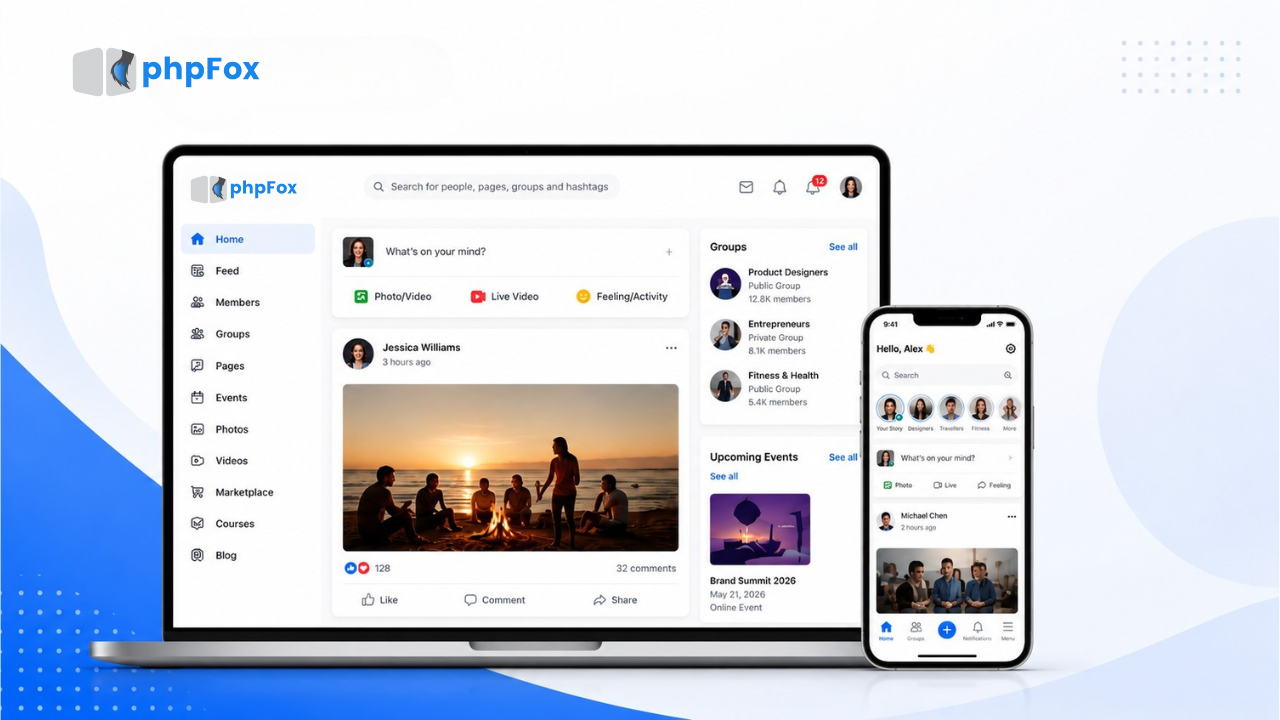
Best for: Businesses, niche social networks, and organizations that need a private, fully branded community platform at scale. phpFox is the strongest choice on this list for businesses that want complete control over their community infrastructure.
Unlike SaaS-based platforms that operate inside a shared ecosystem, phpFox gives you an independent community platform under your own domain, your own infrastructure, and your own business model. That ownership distinction is what separates phpFox from most alternatives. Your member data belongs to you — not the platform. Your revenue model is yours — no percentage taken on transactions. Your branding is end-to-end — from your website to your native iOS and Android mobile app. And your community runs on your terms, with no algorithm deciding your reach and no policy change wiping out years of work overnight.
The platform ships with a comprehensive suite of social networking features out of the box: activity feeds, groups, forums, real-time chat, live streaming, stories, events, pages, marketplace, monetization tools, and native mobile apps. For businesses that view community as a long-term asset rather than a support channel, that depth of functionality becomes genuinely valuable. Built on MetaFox Framework, phpFox also gives developers a modern, flexible architecture to build on — not fight against.
Top Features
- Fully white-label platform — your domain, your brand, your mobile app
- 100% ownership of member data and community infrastructure
- Rich built-in feature set: activity feeds, groups, forums, chat, live streaming, stories, events, marketplace
- Native iOS & Android apps (white-label on Ultimate license)
- Built-in monetization: subscriptions, memberships, paid content, in-app purchases
- Cloud-hosted and self-hosted options
- Modern tech stack: Laravel + React
- Plugin and app ecosystem for extensibility
Pricing
phpFox offers cloud-hosted plans starting from $39/ monthly, as well as self-hosted license options for businesses that want full infrastructure control starting from $299. You can find phpFox Pricing here
If you want to explore how a community platform for creators works in practice, phpFox Free Trial is a good place to start.
2. Circle — Best for Creators & Course-Based Communities
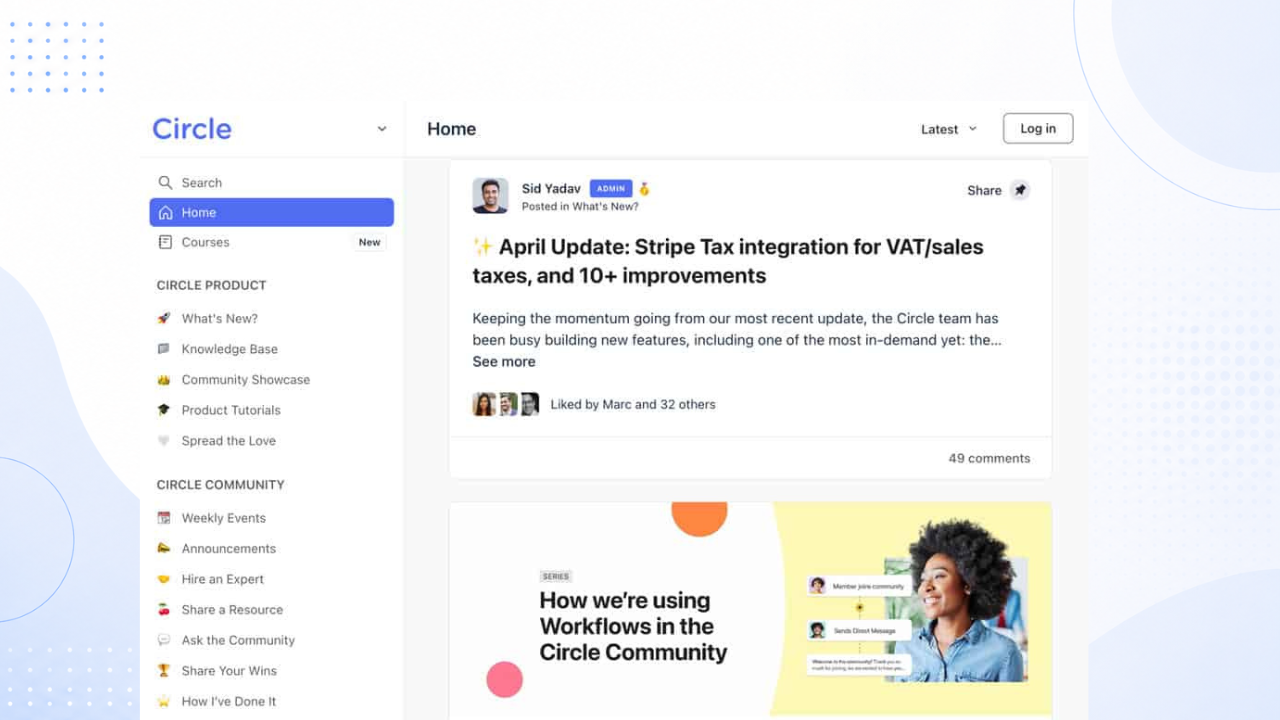
Best for: Educators, online course creators, coaches, and membership communities that want a polished, fast-to-launch community management platform.
Circle has established itself as one of the most refined online community software solutions for creators and educators. It combines community spaces, courses, memberships, live events, and branded mobile apps inside a clean, modern interface — and in 2025, added a full gamification system to address one of its most requested gaps. Where Circle excels is in the quality of its member experience. The interface is polished, onboarding is fast, and the structured spaces approach makes it easy to organize different types of content and conversations without confusion.
For communities where the member experience is the product, Circle delivers. The honest trade-offs are well-documented: limited customization compared to self-hosted alternatives, transaction fees on all pricing plans, and some key features — including full gamification automation and branded apps — gated behind higher-tier plans.
Top Features
- Spaces for discussions, courses, events, live streams, and resources
- Gamification system: points, levels, leaderboards, and custom rewards (added in 2025)
- Branded iOS and Android apps (on higher plans)
- Native live streaming and event management
- Automated workflows for onboarding and engagement
- AI Agents for member support (Enterprise+)
Pricing Circle’s pricing starts at $89/month (billed annually) for the Professional plan, with Business at $199/month and Enterprise plans available on request. Transaction fees apply on all plans. A 14-day free trial is available.
3. Mighty Networks — Best for Lifestyle Brands & Creator Memberships
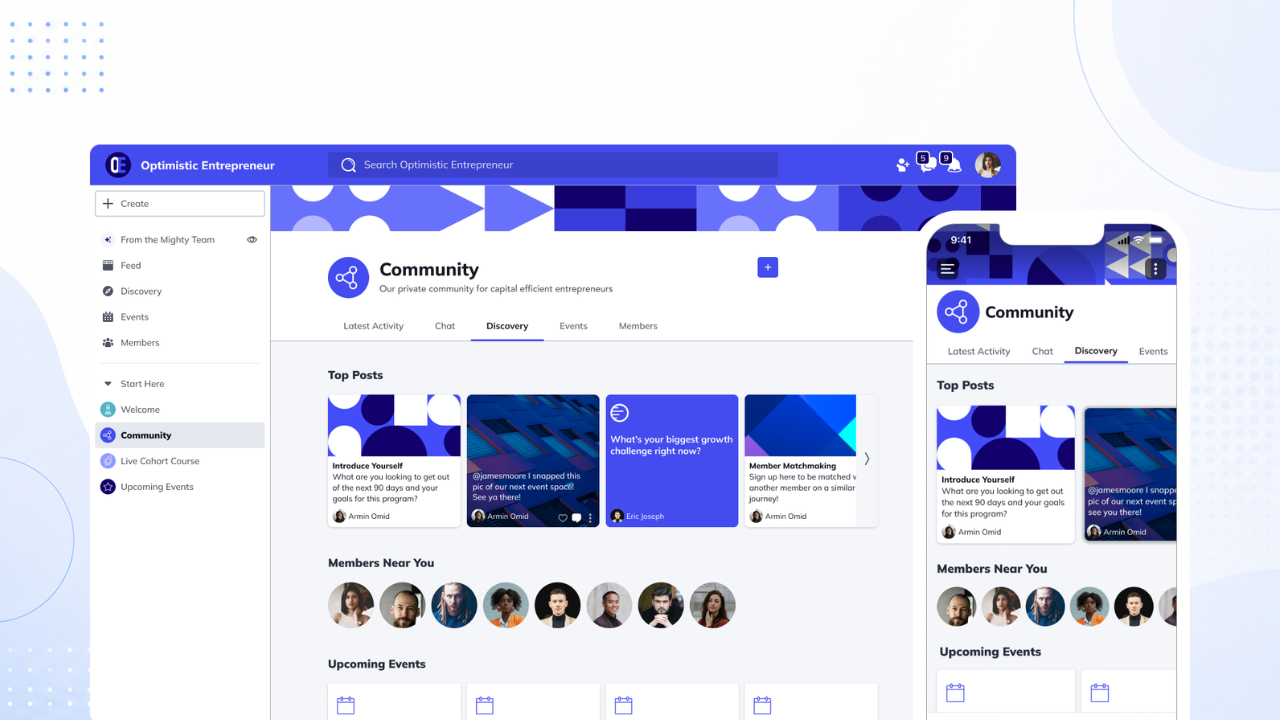
Best for: Lifestyle brands, wellness communities, coaching businesses, and creator memberships that want a social-media-style member community platform.
Mighty Networks has carved out a strong position in the creator economy by combining community features, online courses, events, and gamification in an experience that feels intentionally social. Its activity feed-first approach makes it one of the most engaging environments for communities that thrive on daily member interaction.
The platform includes gamification features — badges, streaks, and engagement mechanics — on its entry plans, which is a meaningful advantage over competitors that gate these features behind premium tiers. The native mobile apps are well-regarded and work reliably across iOS and Android.
Limitations worth knowing: customization hits a ceiling quickly, member management tools are less sophisticated than enterprise alternatives, and the mobile app can feel sluggish on lower-end devices. Some users also report that sales pages and monetization options are less polished than dedicated course platforms.
Top Features
- Social media-inspired activity feeds and member profiles
- Built-in courses, challenges, and events
- Gamification: badges, streaks, and engagement features across plans
- Native iOS and Android apps (branded apps on higher tiers)
- AI Cohost for automated polls, conversation starters, and lesson suggestions
- Multilingual support is rolling out in 2026
Pricing
Mighty Networks plans ranges from $49 to $360 per month. Mighty Pro — which includes fully branded mobile apps — requires a custom quote. All plans include unlimited members and moderators.
4. Skool — Best for Community-First Learning & Coaching Programs
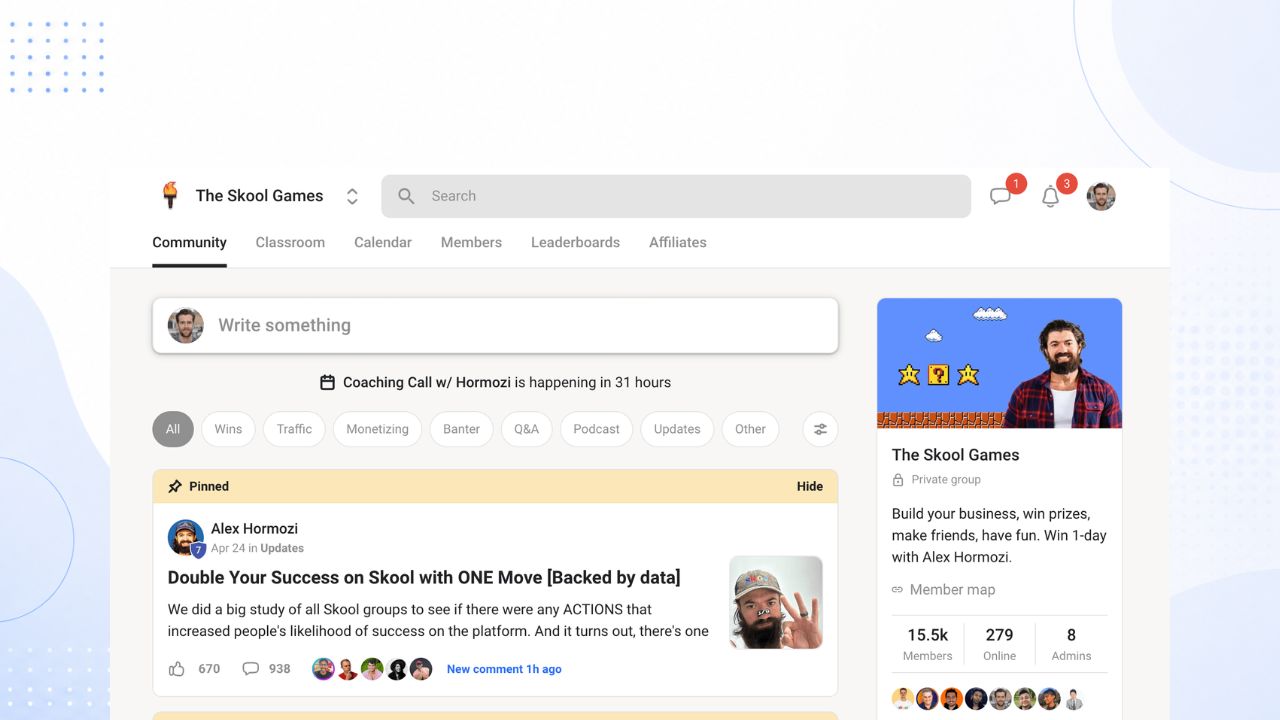
Best for: Coaches, consultants, and course creators who want a simple, gamified online community platform centered on daily member engagement.
Skool was built around one philosophy: community-first learning. It combines discussion forums, online courses, events, and a layered gamification system into one of the most streamlined community experiences available. The platform’s points, levels, and leaderboard system is widely regarded as the most effective gamification implementation in the creator community space.
What makes Skool particularly compelling is its simplicity. Everything is in one place, the interface is intuitive, and the discovery marketplace — which exposes your community to 25 million users browsing for communities to join — provides an organic growth advantage that most platforms don’t offer. The significant limitation is what Skool deliberately leaves out: no email marketing, no sales funnels, no landing pages, no deep branding control. You live at skool.com/yourcommunity. And transaction fees of 2.9% on the Pro plan can become expensive at meaningful revenue levels.
Top Features
- Gamification: points, levels, leaderboards, and content unlocking
- Built-in classroom for unlimited courses
- Community discovery marketplace (25M+ users)
- Native iOS and Android apps
- Calendar with Google Calendar, Apple, and Outlook sync
- Flat-rate pricing with no feature gating between tiers
Pricing
Skool offers two plans: a Kickstarter plan at $9/month and a Pro plan at $99/month. Transaction fees of 2.9% apply on the Pro plan. All features are available across both plans.
5. Kajabi — Best for All-in-One Course & Marketing Businesses
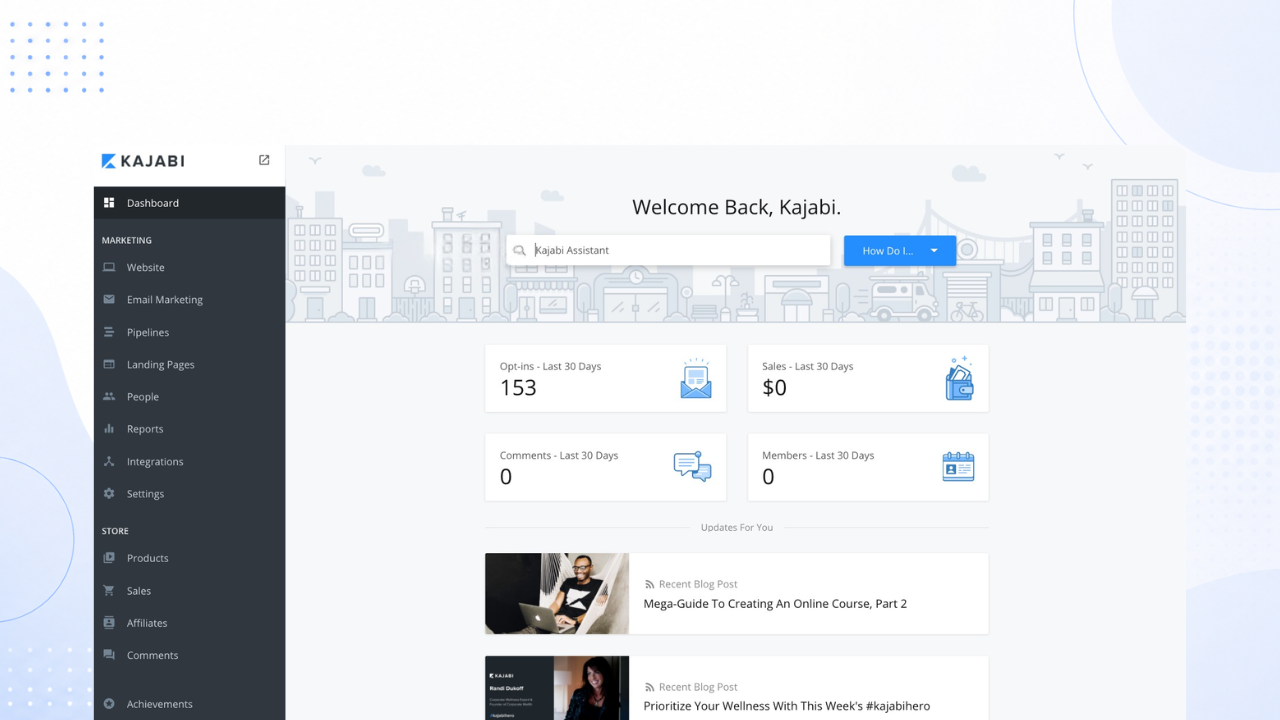
Best for: Established creators and online businesses that need a full marketing suite alongside community engagement software.
Kajabi is the most comprehensive all-in-one platform on this list — email marketing, sales funnels, landing pages, CRM, course delivery, and community features, all under one roof. For creators who want to consolidate their entire online business into a single platform, Kajabi delivers more than any competitor. Community, however, is not where Kajabi shines. Users consistently note that community features feel like an add-on to a marketing and course platform, rather than a core product.
There’s no gamification, no leaderboard, no daily engagement mechanic. Members are less active, and churn tends to be higher compared to community-first platforms. The 2025 pricing restructure also changed the calculus for many buyers — Basic rose to $179/month with a reduced contact limit of 2,500, which pushed thousands of creators toward Circle and Skool.
Top Features
- Full marketing suite: email sequences, funnels, landing pages, and CRM
- Course delivery with drip content, quizzes, and assessments
- Community spaces for discussions and member engagement
- Podcast hosting and video content tools
- 0% transaction fees on all plans
Pricing
Kajabi’s Basic plan starts at $179/month. Growth is $249/month, and Pro is $399/month (monthly pricing). Annual billing offers a discount. No free plan, but a 14-day free trial is available.
6. BuddyBoss — Best for WordPress-Based Communities & Educators
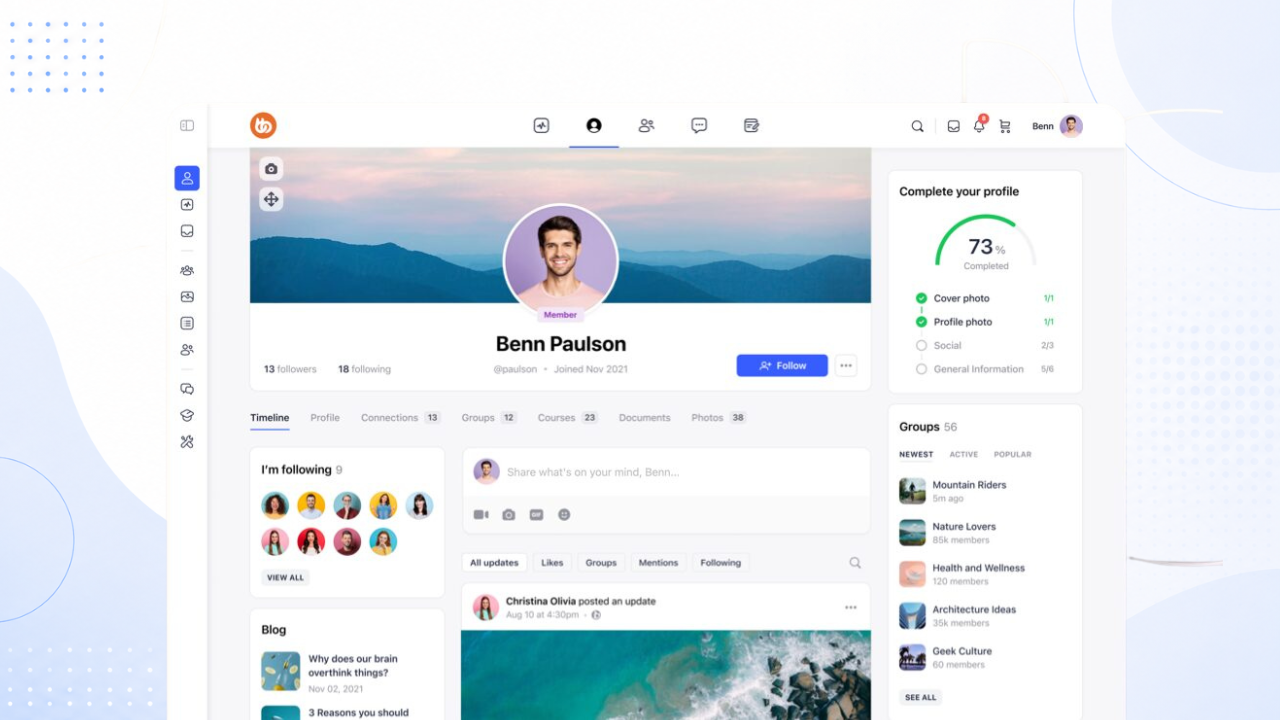
Best for: Businesses already operating on WordPress that need a self-hosted community portal software with deep LMS integration.
BuddyBoss is the go-to online community platform for organizations already invested in the WordPress ecosystem. Built on top of WordPress and BuddyPress, it layers a full-featured community experience — groups, forums, activity feeds, messaging, and member profiles — directly onto your existing WordPress site, without requiring a platform migration. Its deep integration with LearnDash makes it particularly compelling for online educators and course creators who want community and learning management in one environment.
The white-label mobile app for iOS and Android is a meaningful differentiator compared to many SaaS alternatives at similar price points. Plugin compatibility is the most frequently cited challenge — not all plugins integrate cleanly, and updates can introduce unexpected conflicts. The initial setup also has a learning curve that benefits from technical familiarity with WordPress.
Top Features
- Native WordPress integration — no platform migration required
- Deep LMS integration with LearnDash
- White-label iOS and Android mobile app
- Groups, forums, activity feeds, messaging, and member profiles
- Gamification tools and member point systems
- Fully self-hosted — you own your data and infrastructure
Pricing: BuddyBoss Platform starts at $299/year. Combined BuddyBoss + LearnDash packages start at $498/year. No transaction fees. Mobile app source code available as an add-on.
7. Bettermode — Best for SaaS Customer Communities
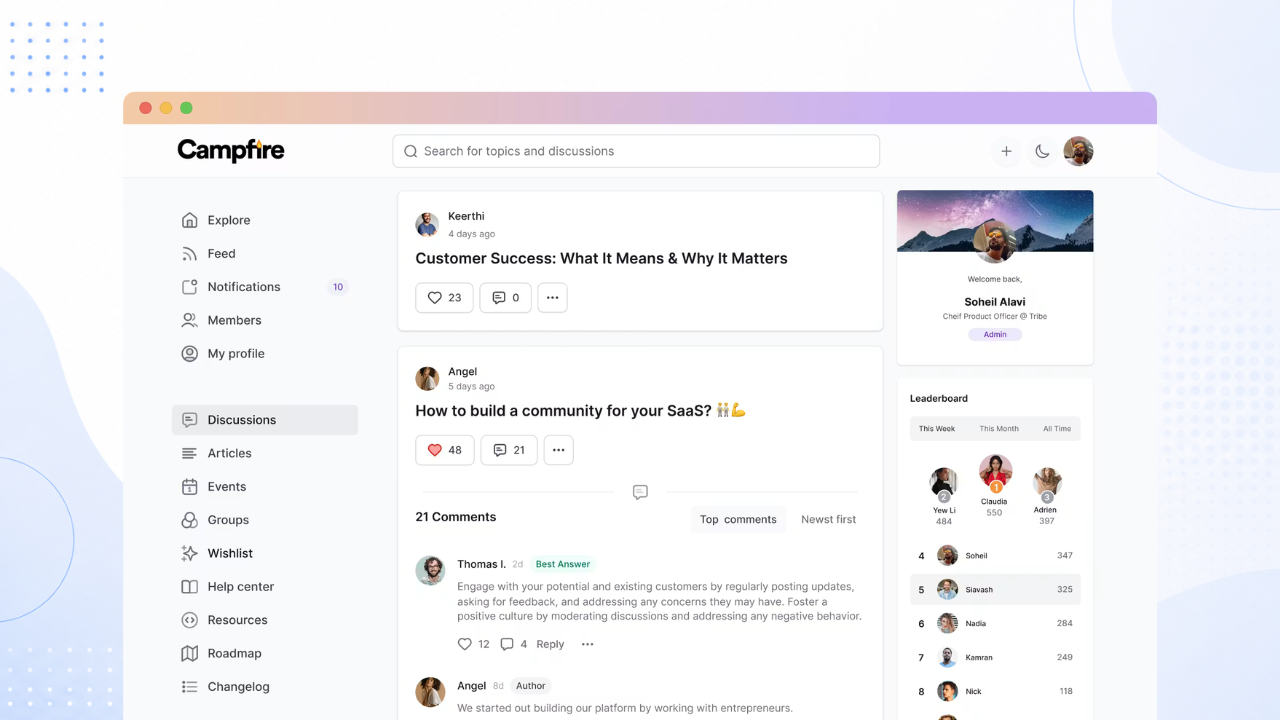
Best for: SaaS companies and software businesses building structured community management platforms around customer success and product feedback.
Bettermode (formerly Tribe) was purpose-built for customer communities — and for that specific use case, it performs well. The flexible space structure works effectively for organizing product feedback, feature requests, forums, and knowledge bases inside a single branded environment. SaaS teams particularly appreciate how it bridges the gap between customer support and community engagement.
The platform’s no-code customization tools allow non-technical teams to build visually branded communities without developer support, and migration from other platforms is generally well-supported. Key limitations: support response times can be slow (some users report 72-hour windows for acknowledgment), and core features like white-labeling require paid add-ons on top of base subscription pricing. Native monetization is not supported — payments require third-party integrations.
Top Features
- Flexible space structure for product feedback, forums, and knowledge bases
- No-code design studio and customizable themes
- AI-powered search and content moderation
- Integrations with SaaS tools and Zapier workflows
- Fast community setup — configurable within days
Pricing: Bettermode offers a free Starter plan for up to 100 members. Paid plans start at $49/month and scale with add-ons. White-labeling is an additional cost.
8. Discourse — Best Open-Source Forum for Developer Communities
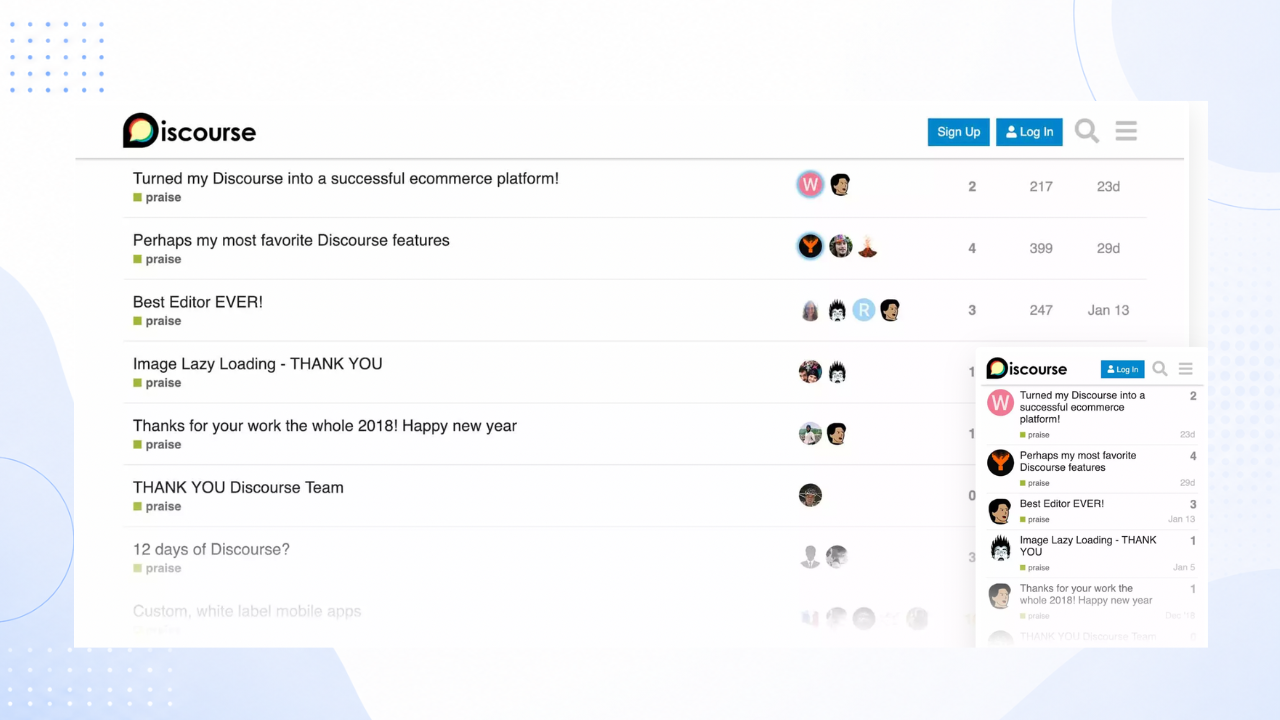
Best for: Developer communities, open-source projects, and technical forums that need a structured, SEO-driven community engagement platform.
Discourse is the gold standard for open-source forum software — and for developer communities and technical ecosystems, it’s often the most appropriate choice on this list. Its sophisticated trust system automatically adjusts user permissions based on participation history, maintaining discussion quality without requiring heavy admin intervention.
Where Discourse particularly stands out is SEO. Community threads generate thousands of pages of keyword-rich, indexed content — meaning your community’s collective knowledge actively drives organic traffic over time. That’s an advantage most modern community platforms don’t offer.
The platform is not designed for social networking, branded creator communities, or mobile-first engagement. Navigation can feel non-intuitive for non-technical users, and meaningful deployment requires server knowledge for self-hosted setups.
Top Features
- Sophisticated trust system for automated quality control
- Excellent SEO performance — forum content ranks on Google
- REST API and plugin ecosystem for deep customization
- Self-hosted option with full data ownership
- Real-time chat alongside long-form threaded discussions
- Strong multilingual and accessibility support
Pricing
Discourse is free to self-host (open source). Managed hosting starts at $100/month. Enterprise plans are available with custom pricing.
9. Facebook Groups — Free to Start, But You Don’t Own Any of It
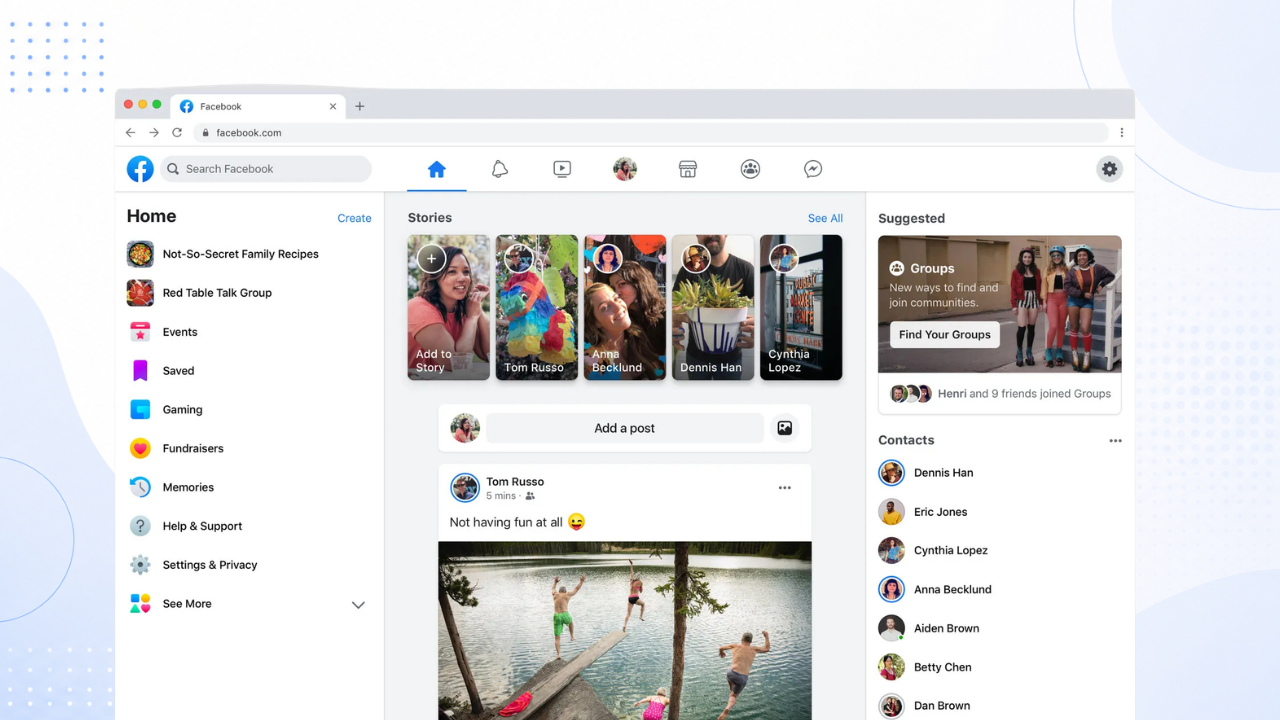
Best for: Early-stage communities testing an idea with zero budget, or brands using Facebook Groups as a top-of-funnel channel before moving to an owned platform.
Facebook Groups remain the default starting point for many community builders — and there are real reasons for that. It’s free, your audience is already there, and members don’t need to create a new account or learn a new platform to participate.
But the trade-offs are structural, not cosmetic. You don’t own your member data. The algorithm controls who sees your content, not you. Policy changes can affect your community overnight without notice. And there’s no meaningful branding, monetization, or mobile app experience under your own identity.
For brands serious about building community as a business asset, Facebook Groups functions better as a discovery and acquisition channel than a long-term community home. The most common path is using Facebook Groups to grow an initial audience, then migrating to an owned platform once the community has traction.
Top Features
- Free to use — zero platform cost
- Large existing user base — your audience is already there
- Zero onboarding friction for members
- Basic event and live video functionality
Pricing
Free. No paid plans available.
How to Choose the Right Online Community Software
With nine strong options on this list, the right choice comes down to four questions:
Who owns the data? If long-term sustainability matters, choose a platform where your member data, content, and community history belong to you — not the platform provider.
What does your community actually need? A creator membership needs different tools than a SaaS customer community or a developer forum. Match the platform to the use case, not the other way around.
What’s your budget — now and in two years? Some platforms are affordable at launch but scale in price as your community grows. Factor in transaction fees, add-ons, and per-member pricing before committing.
Do you need to own the mobile experience? In 2026, a branded native mobile app is increasingly the difference between a community member’s visit and one they forget about. Platforms like phpFox, BuddyBoss, and Mighty Networks offer this — others don’t.
The best online community software isn’t the one with the most features. It’s the one built for how you want to grow — and that gives you the ownership and control to build something that lasts.
Final Thoughts
Choosing the right online community software isn’t a one-size-fits-all decision. The best platform for your organization depends on your goals, audience, budget, and the type of community you want to build. A solution that works well for a creator-led membership site may not be the right fit for a customer community, professional network, or private social platform.
As online communities continue to play a bigger role in customer engagement, member retention, and audience growth, investing in the right foundation becomes increasingly important. Beyond features alone, look for a platform that offers the flexibility to evolve with your needs, the scalability to support long-term growth, and the ownership and control needed to create a truly branded experience.
The most successful communities aren’t built overnight. But with the right online community platform, you’ll be better positioned to foster meaningful connections, deliver ongoing value, and build a community that continues to thrive for years to come.
Online Community Software FAQs
What is online community software? An online community software is a dedicated digital space where people with shared interests, goals, or challenges come together to connect, learn, and support each other — hosted under a brand or organization rather than on a general social media network.
What’s the difference between online community software and social media? With social media, you’re building on someone else’s infrastructure — their algorithm, their data policies, their rules. A dedicated community management platform gives you a branded space you control: your member data, your revenue model, and your community experience, without platform dependency.
Which online community platform is best for full ownership? phpFox is the strongest option for brands that need complete ownership — of their data, their platform, their monetization model, and their branded mobile app. It’s a self-hosted or cloud-hosted solution that gives you full infrastructure control without the limitations of SaaS alternatives.
How much does online community software cost? Costs vary significantly depending on the platform and model. SaaS platforms like Circle start at $89/month and scale with features and member count. Self-hosted platforms like phpFox require a higher upfront investment but offer lower long-term costs as your community grows. Always factor in transaction fees, add-ons, and future scaling costs before committing.
Can I migrate my community from one platform to another? Yes — and many communities do exactly this as they outgrow their initial platform. The earlier you start on the right foundation, the less disruption migration causes. Platforms like phpFox and BuddyBoss are common destinations for communities moving away from SaaS tools or social media groups.