Most people ask the same question when they think about building a community:
How much does it cost?
And while that’s a fair question, it’s usually the wrong place to start.
Because when you decide to build your own online community, you’re not just paying for a tool or a platform — you’re building something that can grow, generate revenue, and become a long-term asset for your business.
The problem is, many people only look at the upfront cost.
They compare subscription fees, setup expenses, or development budgets, without considering what they’re actually getting in return — and more importantly, what they might be missing by relying on platforms they don’t fully control.
That’s where the real question should be:
👉 Is it worth it in the long run?
In this article, we’ll break down the real cost of building your own online community, what ROI actually looks like, and whether it’s a smart investment depending on your goals — so you can make a decision based on value, not just price.
What Does It Cost to Build Your Own Online Community?
When you decide to build your own online community, the cost can vary depending on how you approach it — but more importantly, it’s not just about how much you pay upfront, it’s about how those costs evolve over time.
In general, there are two common paths: using a SaaS platform or building on a self-hosted solution.
With SaaS platforms, the starting cost is usually low. You can launch quickly with a monthly subscription, which makes it appealing in the early stages. But as your community grows, so do the costs — whether it’s per-user pricing, feature upgrades, or additional tools you need to extend functionality.
Over time, what looked affordable at the beginning can turn into a recurring expense that scales with your growth.
On the other hand, a self-hosted setup often requires a higher upfront investment, but gives you more control over your long-term costs. Instead of paying continuously for access, you’re investing in a platform you own, where scaling doesn’t necessarily mean paying more to the platform itself.
But beyond these visible costs, there’s another layer that many people overlook.
Things like integrations, payment fees, support services, or limitations that force you to upgrade earlier than expected can quietly increase your total spend — especially if your platform isn’t designed to grow with you.
That’s why looking at cost alone doesn’t give you the full picture.
Because in the end, the real question isn’t just how much it costs to build your own online community — it’s what you’re getting in return for that cost.
What Does ROI Look Like When You Build Your Own Online Community?
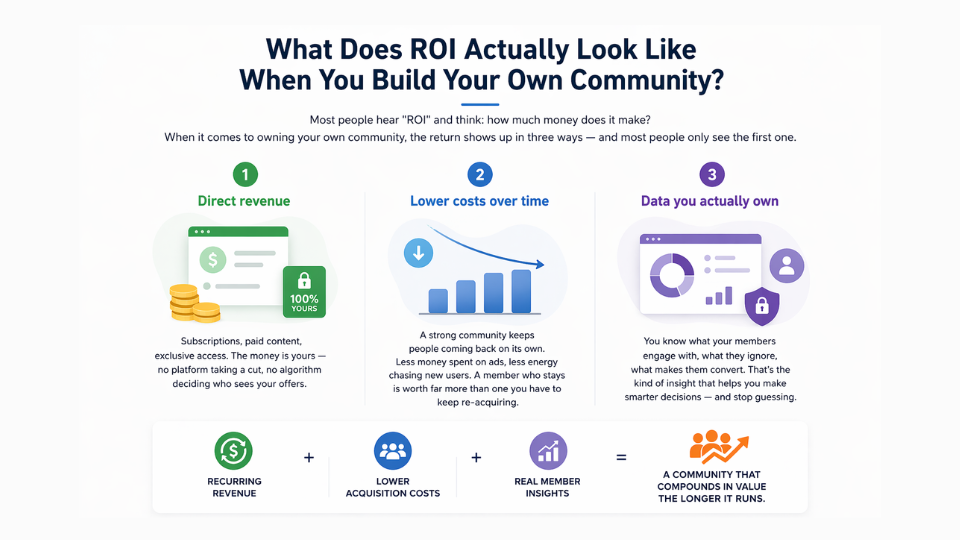
Most people hear “ROI” and think: how much money does it make? When it comes to owning your own community, the return shows up in three ways — and most people only see the first one.
- Direct revenue Subscriptions, paid content, exclusive access. The money is yours — no platform taking a cut, no algorithm deciding who sees your offers.
- Lower costs over time A strong community keeps people coming back on its own. Less money spent on ads, less energy chasing new users. A member who stays is worth far more than one you have to keep re-acquiring.
- Data you actually own You know what your members engage with, what they ignore, what makes them convert. That’s the kind of insight that helps you make smarter decisions — and stop guessing.
Put it all together: recurring revenue + lower acquisition costs + real member insights = a community that compounds in value the longer it runs. That’s not a quick win. But it’s the kind of return that actually builds something.
SaaS vs Self-Hosted: Which Delivers Better ROI?
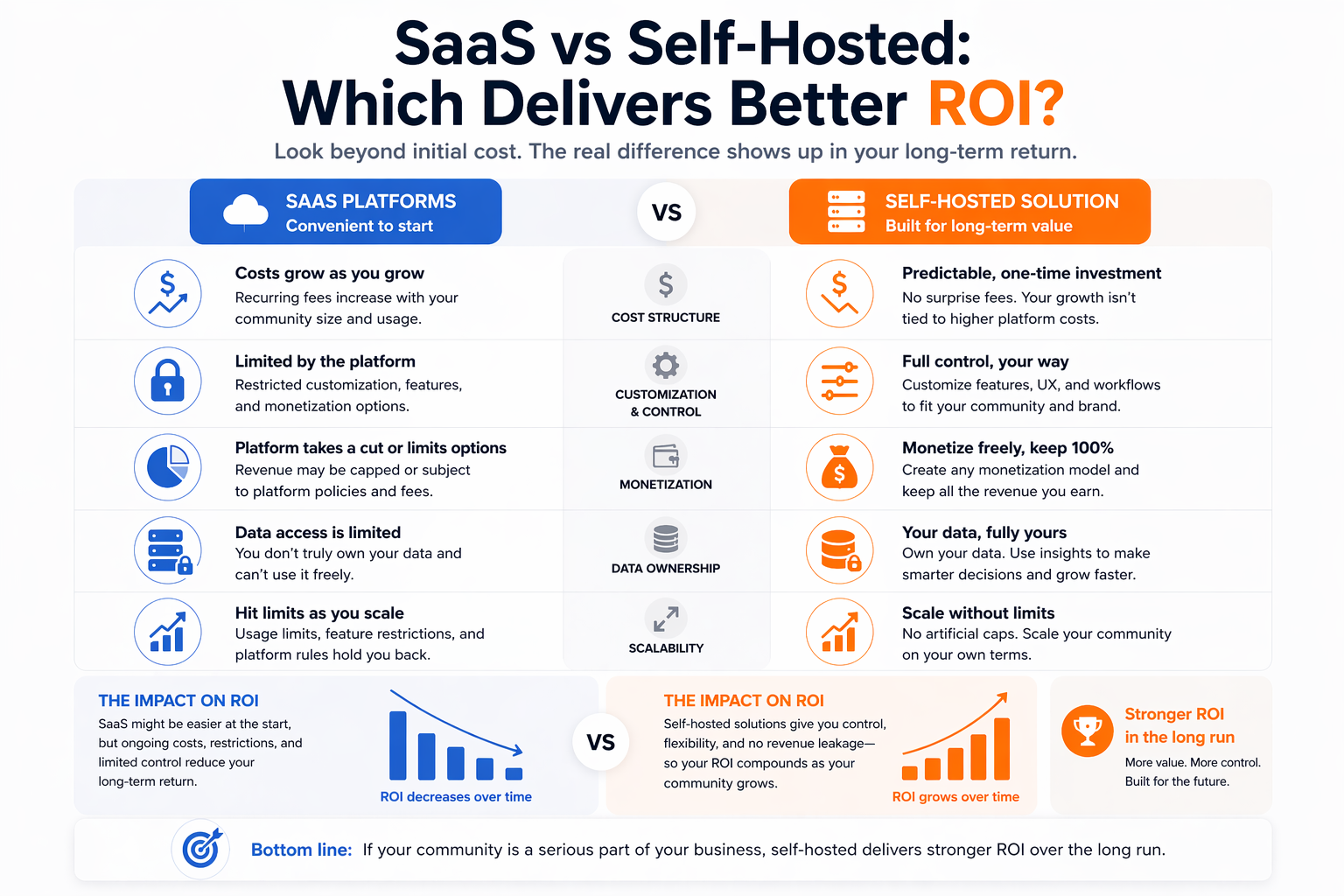
Once you start looking at ROI instead of just cost, the difference between SaaS platforms and a self-hosted approach becomes much clearer.
SaaS platforms are built for convenience. You can launch quickly, manage everything in one place, and avoid technical setup. But that convenience comes with a trade-off — your costs grow as your community grows, and your ability to customize, monetize, or access data is often limited by the platform.
This directly impacts your ROI.
Because even if you’re generating revenue, a portion of that value is tied to ongoing fees, platform restrictions, or limitations that prevent you from fully optimizing your community.
With a self-hosted solution, the model shifts.
Instead of paying continuously for access, you’re investing in something you own. Your costs are more predictable, and your growth isn’t tied to increasing platform fees. More importantly, you have full control over how your community operates — from features and user experience to monetization and data usage.
That control has a compounding effect on ROI.
You can experiment faster, adapt your business model, and scale without hitting artificial limits. Over time, the value you generate stays within your ecosystem instead of being shared with a third-party platform.
So while SaaS may feel like the easier option at the start, a self-hosted approach often delivers stronger ROI in the long run — especially if you’re building your community as a serious part of your business.
When Building Your Own Community Is NOT Worth It
Building your own community can deliver strong ROI — but only if you’re ready for it.
If you don’t have a clear audience, a defined value, or a reason for people to stay, then the platform alone won’t make your community work.
It’s also not a short-term play.
Communities take time to grow, and without a plan for content and engagement, it’s easy to lose momentum after launch.
So before you decide to build your own online community, ask yourself:
- Do you know who your community is for?
- Do you have a clear value to offer?
- Are you ready to invest time into growing it?
If yes, it can become a powerful long-term asset.
If not, it’s better to build your audience first — then scale into your own platform.
Conclusion: Build for Growth, Not Just Convenience
Building a community isn’t just about bringing people together — it’s about creating something that holds value over time.
If you only look at cost, it may not seem worth it at first. But when you look at ROI — from recurring revenue, stronger retention, and full control over your data — the picture becomes very different.
Because in the long run, the real question isn’t “how much does it cost?”
It’s “what does it become?”
Start building your own online community today and turn it into something you truly own.