Facebook Groups used to be the easiest way to bring people together online. You create a group, invite members, start posting—and just like that, you have a community. But as your community grows, so do the limitations.
You don’t control who sees your content. The algorithm does.
You don’t own your member data. The platform does.
And every interaction inside your group is competing with ads, notifications, and endless distractions. That’s why more creators, founders, and businesses are actively looking for Facebook group alternatives—not just to grow a community, but to actually own it. Instead of building on borrowed land, the shift is clear: people want to build their own community platform—a space where they control the experience, the data, and the future of their brand.
In this guide, we’ll explore why Facebook Groups fall short for long-term community growth—and introduce some of the best Facebook Group alternatives available today.
When Should You Leave Facebook Groups?
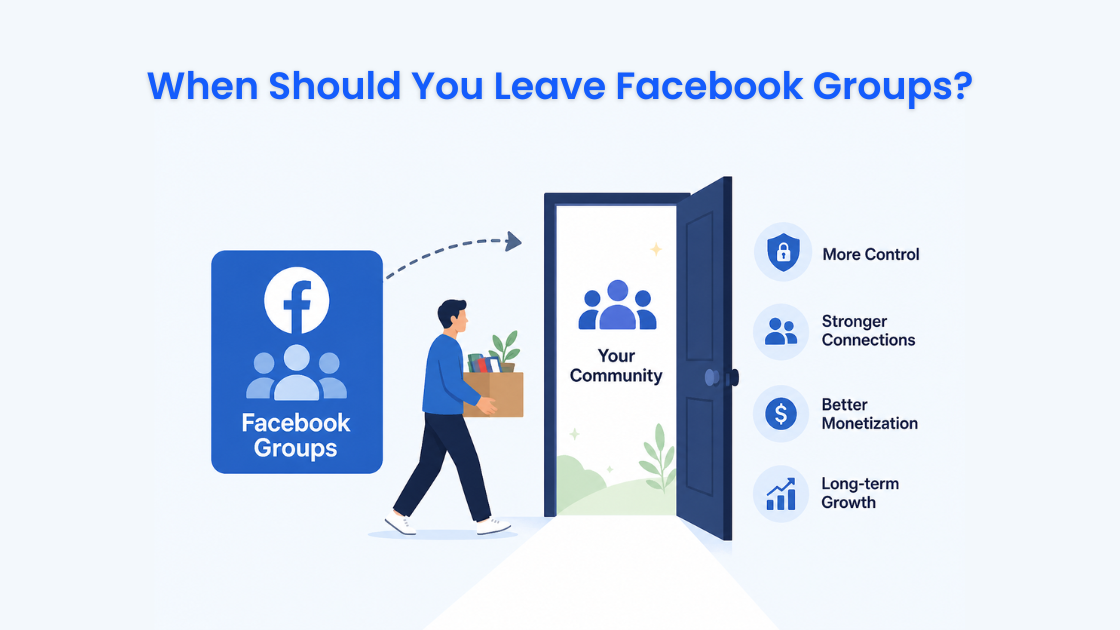
Not everyone needs to leave Facebook Groups right away. In fact, for early-stage communities, it can still be a great place to start. The problem isn’t that Facebook Groups don’t work—it’s that they stop working at a certain point. The real question is knowing when you’ve reached that point.
One clear sign is when you start thinking about monetization more seriously. If you’re trying to turn your community into a revenue stream—whether through memberships, courses, or premium content—you’ll quickly feel the limitations. Managing payments outside the platform, sending people to different tools, and trying to hold everything together becomes unnecessarily complicated.
Another moment is when your brand starts to matter more. In the beginning, a Facebook Group is “good enough.” But as you grow, you may want a space that actually reflects your identity, not one that looks like every other group on the platform. That’s usually when the idea to build your own community platform starts becoming more appealing – We’ve put together a detailed guide to help you build your own online community platform here.
Control is another big factor. If you’ve ever worried about reach dropping, posts not being seen, or changes in Facebook’s policies affecting your community, you’re already experiencing the downside of not owning your platform. That uncertainty alone is enough for many founders to start exploring Facebook group alternatives.
In reality, most people don’t leave Facebook Groups because they want to—they leave because they’ve outgrown them. And that’s the shift: from using a tool that’s convenient, to investing in something that’s sustainable.
Why People Are Moving Away from Facebook Groups
At first, Facebook Groups feel like the easiest way to build a community. Everything is already there—you just create a group, invite people in, and start posting. But once your community grows beyond a certain point, the limitations become very real, and they tend to show up in the same few ways.
Limited control over your community is usually the first thing people notice. You might have thousands of members, but only a fraction actually see your posts because the algorithm decides what gets surfaced. More importantly, you don’t own your audience. The data, the relationships, even the access—all of it sits with Facebook. That’s why when people start comparing facebook groups vs community platforms, ownership becomes the deal breaker.
Distractions are the next problem that slowly kills engagement. Even when members intentionally visit your group, they’re still inside Facebook’s ecosystem—surrounded by ads, notifications, and endless content competing for attention. Over time, conversations become shorter, less meaningful, and harder to sustain, not because your community is weak, but because the environment isn’t built for focus.
Branding is another invisible limitation that becomes obvious later on. No matter how unique your community is, it still looks and feels like every other Facebook Group. You can’t shape the experience, design your own flow, or create a space that truly reflects your identity. And when everything feels the same, it’s harder to build something memorable.
Monetization is where things start to feel messy. Facebook Groups weren’t designed to support a real business model. If you want to offer memberships, sell courses, or create paid experiences, you’ll end up stitching together multiple third-party tools. It works—but it’s far from seamless, and definitely not scalable.
And finally, long-term growth becomes a challenge. Facebook Groups are great for getting started, but they’re not built to evolve with you. As your community matures, you’ll want better structure, deeper engagement, and more control over how everything runs. That’s the point where many founders realize they don’t just need a group anymore—they need real community platform software.
That shift is exactly why more people are now looking for Facebook group alternatives—not because Facebook doesn’t work, but because it stops working at scale.
Facebook Groups vs Community Platform: Key Differences
At a glance, Facebook Groups and dedicated community platforms might seem similar—they both bring people together and enable conversations. But the way they operate underneath is completely different.
The real distinction comes down to one thing: are you building on someone else’s platform, or building something you actually own?
Here’s a clearer side-by-side comparison:
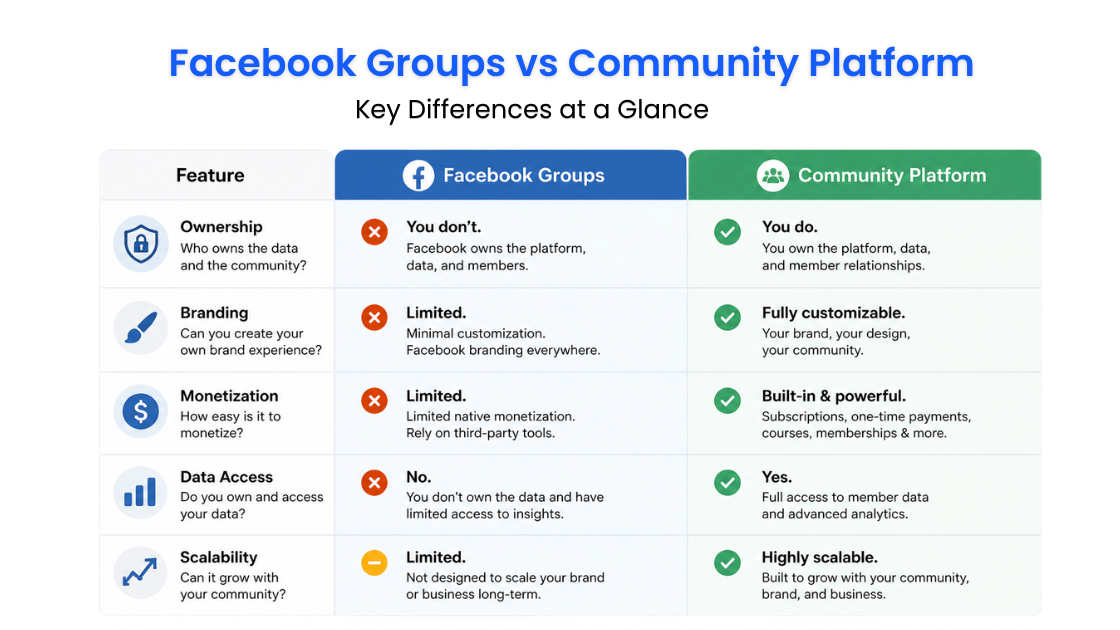
What this comparison really highlights is the long-term impact of your choice.
With Facebook Groups, you’re optimizing for convenience. It’s fast, familiar, and easy to start—but you’re always playing within someone else’s rules. With a dedicated platform, you’re building an asset. You have full control over how your community grows, how it generates revenue, and how it evolves over time.
That’s why the conversation around Facebook groups vs community platforms isn’t just about features—it’s about ownership, sustainability, and the future of your community.
What Makes Good Facebook Group Alternatives?
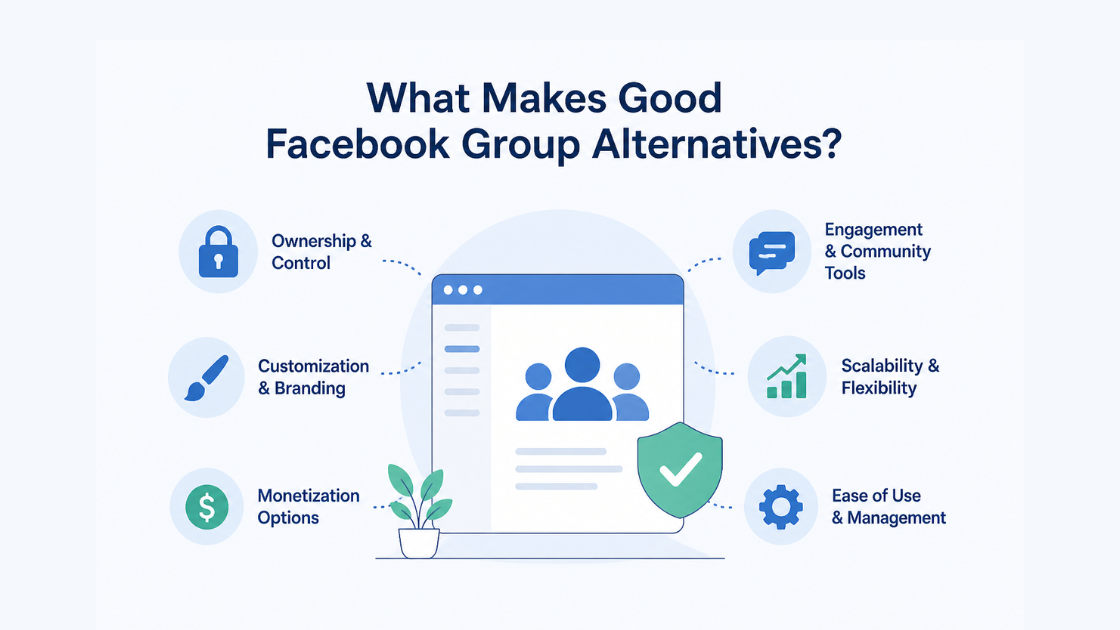
Not all Facebook group alternatives are actually better—some just recreate the same problems in a different form. If you’re serious about growth, the goal isn’t to “switch platforms,” it’s to build your own community platform that you actually control.
A strong community platform software should cover a few core things:
- Ownership & control
You fully own your data, your members, and everything happening inside your community. There’s no algorithm deciding who sees your content, and no risk of losing access if the platform changes its rules. It’s your space, on your terms. - Custom branding & experience
Your community should feel like an extension of your brand—not just another generic page. From layout to user flow, you can shape the entire experience so it reflects your identity and creates a more immersive environment for members. - Built-in monetization
Instead of relying on third-party tools, you can create revenue streams directly within your platform. Whether it’s memberships, premium content, or courses, everything runs seamlessly in one place without breaking the user experience. - Scalability
What works for a small group should still work as your community grows. A solid platform gives you the structure and flexibility to handle more members, more content, and more interactions without everything becoming messy or hard to manage. - All-in-one ecosystem
Rather than juggling multiple tools, everything you need lives in a single system. Content, discussions, monetization, and management all connect smoothly, helping you run your community more efficiently and deliver a better experience overall.
Best Facebook Group Alternatives (Top Platforms)
Once you know what to look for, the next step is choosing the right platform. The challenge here isn’t a lack of options—it’s figuring out which one actually fits your long-term goals.
Some tools are great for getting started but limit you later. Others are powerful but require more investment upfront. Below are some of the most popular Facebook group alternatives, each with its own strengths depending on how you want to build your own community platform.
phpFox – Best Self-hosted Community Platform
If your goal is to build something you truly own and scale long-term, phpFox stands out as one of the most complete solutions.
Unlike platforms that lock you into their ecosystem, phpFox gives you full control over your community—from data ownership to customization and monetization. It’s designed for founders and businesses who don’t just want a group, but a fully functional social platform.
What makes it different is how everything is built into one system. You’re not stitching together tools—you’re launching a complete community experience from day one. With features like groups, subscription, activity feeds, marketplaces, and even mobile apps, it goes far beyond what Facebook Groups can offer.
It’s especially strong if you’re serious about growth. You can design your platform around your niche, monetize directly, and scale without worrying about platform limitations.
👉 If you’re looking for a true community platform software to build your own community platform, phpFox is less of an alternative—and more of an upgrade.
Mighty Networks – Best for Course Creators
Mighty Networks is a popular choice for creators who focus on courses and memberships.
It combines community features with learning tools, making it easier to host content and discussions in one place. For creators selling knowledge products, this can be a convenient setup.
That said, customization is somewhat limited, and you’re still operating within their ecosystem. It works well for structured communities, but may feel restrictive if you want full control over branding and features.
Circle – Best for Simple, Clean Communities
Circle is known for its clean interface and ease of use.
It’s a solid option if you want a lightweight community platform without too much complexity. Setup is quick, and the user experience feels modern and focused.
However, it’s more suited for smaller or simpler communities. As you grow, you might find limitations in features and flexibility compared to more robust platforms.
Discord – Best for Real-Time Communities
Discord is a go-to choice for real-time interaction, especially in gaming, tech, or creator communities.
It’s great for fast conversations, live engagement, and building a sense of immediacy. If your community thrives on constant interaction, Discord can be very effective.
The downside is structure. Content gets lost quickly in chats, and it’s not ideal for organizing long-form discussions or building a scalable knowledge base.
Slack – Best for Small Private Groups
Slack is often used for small, focused communities or internal groups.
It’s clean, familiar, and works well for tight-knit conversations. But it wasn’t built for public or large-scale communities. Over time, it can become expensive and difficult to manage as your member base grows.
At the end of the day, the right choice depends on what you’re building. If you just need a place to chat, simpler tools might work. But if you’re aiming to create a long-term asset, choosing the right Facebook Group Alternative becomes a strategic decision—not just a technical one.
Final Thoughts
Facebook Groups are a great place to start. But they were never designed to help you build something you truly own.
As your community grows, the trade-offs become harder to ignore—limited control, scattered attention, weak monetization, and no real sense of ownership. What once felt convenient starts to feel restrictive.
That’s why more creators and businesses are moving toward Facebook Group Alternatives—not just to improve the experience, but to shift their mindset ftrirom building on borrowed platforms to investing in something they control long-term.
When you build your own community platform, you’re not just creating a space for conversations. You’re building an ecosystem around your brand—one that can grow, evolve, and generate value over time.
If you’re serious about moving beyond Facebook Groups, it’s time to stop building on borrowed platforms and start creating something that’s truly yours. With phpFox, you get everything you need to launch and grow your own community platform—without relying on third-party tools or platform limitations.