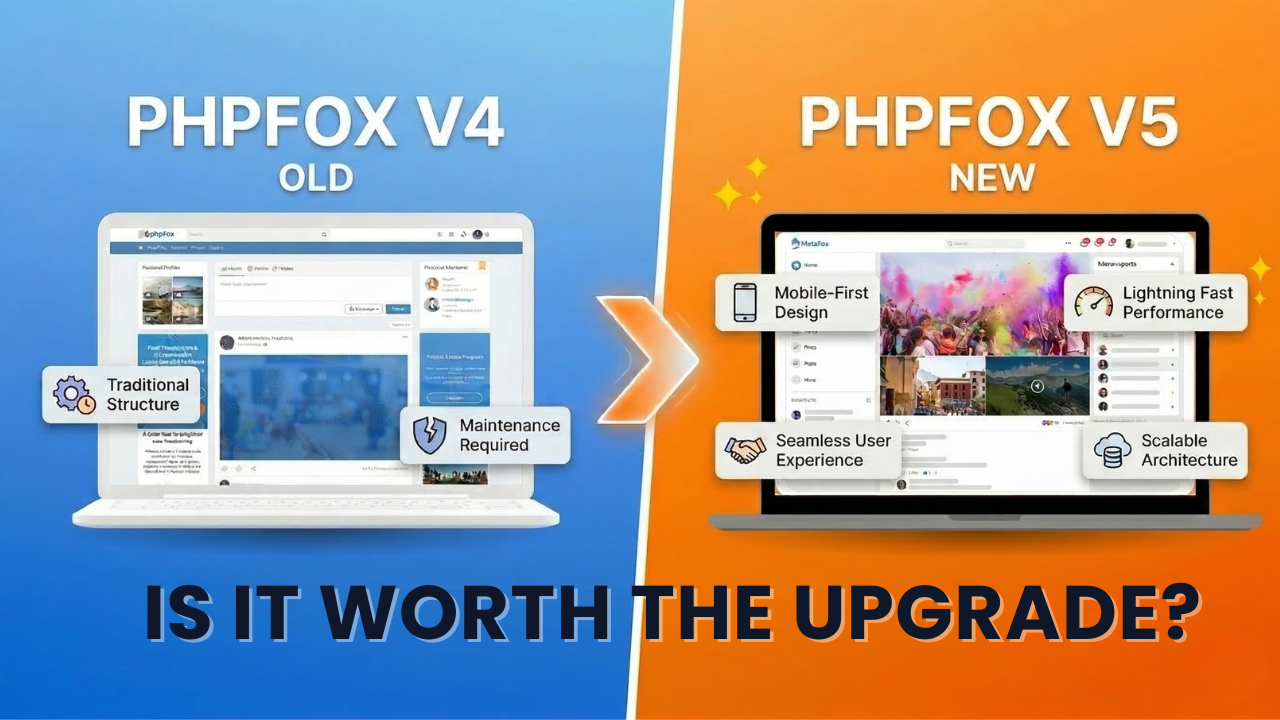
If you’ve been running your community on phpFox V4 for a while and everything is still fine, upgrading phpFox V4 to V5 probably isn’t something you’ve been thinking about every day — and that makes sense, because as long as your site is still running, still serving users, and not causing immediate problems, it’s easy to assume that staying where you are is the safer choice.
For many of you, phpFox V4 is no longer just a platform, it’s something you’ve already invested heavily in — not just in terms of license cost, but in apps, custom features, and all the adjustments that made your community work the way you needed it to.
But what we’ve seen over time — and what many V4 customers quietly experience — is that staying on an older version doesn’t actually mean things stay the same. In this blog, we will walk you through the risks you may face if you stay on phpFox v4 that is no longer actively maintained, and how upgrading to phpFox V5 can help eliminate them.
What happens if I stay on phpFox V4 long term?
As long as your community is still running, users are still active, and nothing is obviously broken, it’s easy to assume that you can keep things as they are. And in the short term — you probably can.
If you’re thinking long-term, these are the risks that tend to matter the most. Here’s a closer look at each of them.
1. Security risks increase quietly
Security is one of those areas that often feels “fine” until something actually happens.
With V4 no longer receiving security patches, any newly discovered vulnerabilities simply stay there. Over time, that creates a growing surface area for potential attacks, whether it’s spam, injected code, unauthorized access, or more serious data breaches.
And it’s not just about what’s already known. Security standards themselves continue to evolve — things like stricter HTTPS enforcement, CSP policies, and modern authentication practices. An older system doesn’t just miss updates; it gradually falls behind what is considered “safe” by today’s standards.
We’ve seen community owners only start to take this seriously after something happens — when a site gets compromised, when user data is affected, or when trust is lost. And by then, the cost — both in time and impact — is significantly higher than it would have been to prevent them.
2. Compatibility issues that slowly turn into real blockers
Technology doesn’t stand still — even if your platform does.
As hosting providers move forward, older PHP versions eventually reach end-of-life and are no longer supported. At that point, you’re forced into a difficult position: either stay on outdated infrastructure (with increasing risk), or upgrade your environment and hope everything still works.
The problem is, phpFox V4 wasn’t built with newer environments in mind. So when you move to newer PHP versions, things can break — sometimes quietly, sometimes in ways that take your site down entirely. And beyond PHP, the same applies to payment gateways, social login providers, and other third-party integrations that continue updating their APIs.
In the short term, you can patch around these issues. In the long term, they become structural limitations.
3. No official support means every issue becomes your responsibility
When a platform is actively maintained, there’s always a safety net — bug fixes, updates, guidance, and a team that stands behind the product.
With phpFox V4, that layer is no longer there. So when something breaks, or doesn’t work as expected, there’s no official fix coming. Issues don’t get resolved upstream — they stay where they are, and it’s up to you to deal with them. For some community owners, that means spending time troubleshooting things themselves. For others, it means hiring developers to step in. Either way, what used to be part of the product becomes an extra cost.
And over time, that shift adds up — not just financially, but in how much energy it takes to keep your platform stable.
4. An outdated experience that affects how users engage
User expectations don’t stay the same. What felt like a solid experience a few years ago can start to feel slow, clunky, or outdated today — especially as people compare your platform to modern apps and communities they use every day.
On phpFox V4, limitations in UI/UX, performance, and mobile optimization make it harder to keep up with those expectations. And if you’re running a mobile app, the risk becomes even more immediate. App stores regularly update their requirements, and apps that aren’t maintained or rebuilt accordingly can be rejected, delayed in review, or even removed entirely.
Upgrading to phpFox V5 helps eliminate these risks. With ongoing updates aligned to the latest platform requirements, your app is more likely to pass reviews smoothly and get approved faster—so you can release updates without unnecessary delays. More importantly, it ensures your users get a stable, seamless experience, without the disruptions that often come from outdated systems.
In the end, it’s not just about keeping your platform running—it’s about keeping it relevant, competitive, and engaging for the people who use it.
5. Your platform slowly falls out of sync with modern technology
With phpFox V4, the ecosystem isn’t just slowing down — it has already stopped. Fewer developers continue building or maintaining apps, plugins, and integrations. New apps are no longer being developed or published for phpFox V4, and existing ones aren’t receiving updates anymore. All new features, improvements, and innovations are now focused on phpFox V5.
What that means in practice is this: what you currently have will continue to work — but it will stay exactly where it is. And for many community owners, that creates a different kind of limitation — not because things stopped working, but because it becomes harder to make them better. You no longer have access to what comes next — whether that’s new functionality, better integrations, or simply better ways to grow and evolve your community.
6. Hidden costs that are easy to underestimate
On the surface, staying on phpFox V4 can feel like the more cost-effective choice. There’s no upfront upgrade cost, no migration effort, no immediate change. But over time, the costs don’t disappear — they just shift.
You might think you’re saving cost by not upgrading, but in reality, you end up spending it on custom fixes. Instead of getting regular updates, you’re dealing with random issues as they come up. And rather than using built-in improvements, you’re stuck maintaining an older system bit by bit.
Individually, these costs don’t always look significant. But together, over months or years, they often exceed what it would have taken to move forward earlier. And that’s usually the moment when many community owners start reconsidering .
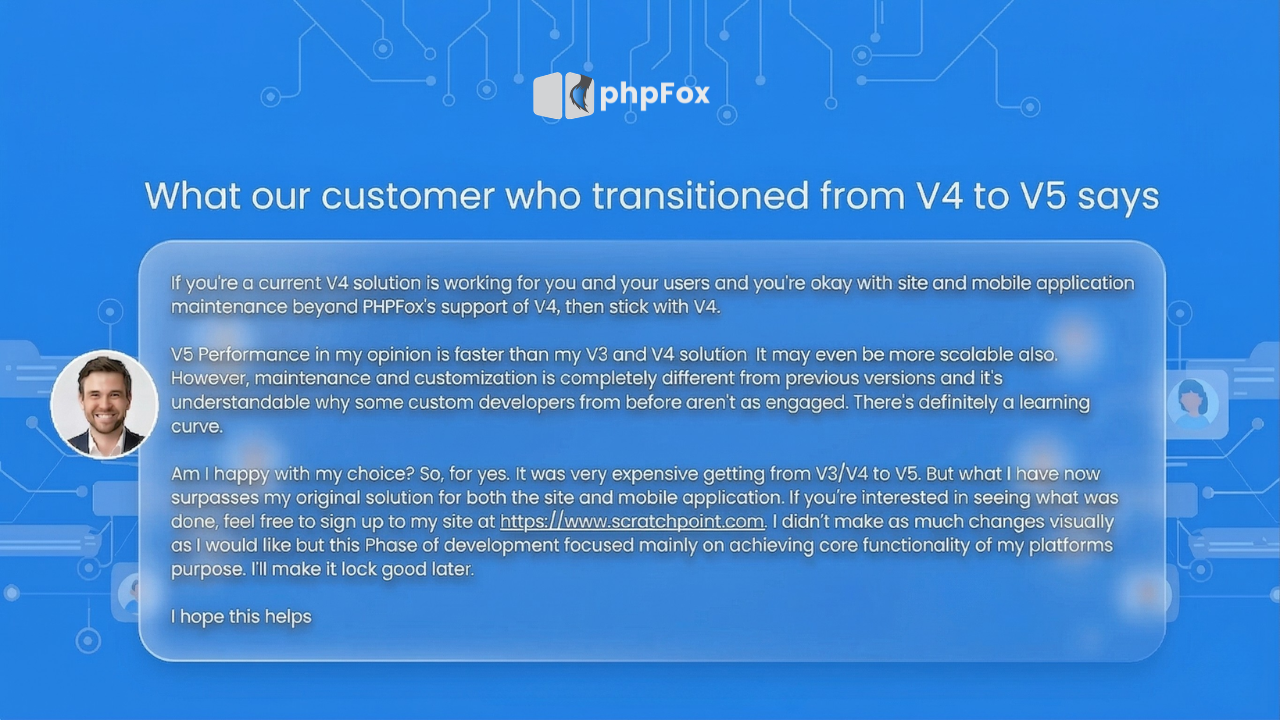
One of our phpFox V4 customers recently moved to phpFox V5 and has been really happy with the switch. Here is what he shared his experience in the phpFox community.
What changes when you move to phpFox V5?
If staying on phpFox V4 is mostly about keeping your platform running, then upgrading to V5 is about turning what you’ve built into something that can actually generate revenue.
1. Turn your community into a real revenue engine
A lot of you didn’t just build a community for the sake of it. You invested time, money, and energy into growing something meaningful — but monetization has often felt like an afterthought, or something that required stitching together multiple tools just to make it work.
With phpFox V5, that part becomes more natural. Instead of relying on workarounds, you have built-in ways to manage transactions and user balances through an integrated wallet system, along with support for modern payment methods like Apple Pay, Google Pay, and even crypto via NowPayments. But more importantly, it’s not about the payment methods themselves — it’s about what they enable.
It becomes easier to introduce paid features, gated content, memberships, or any model that fits your community, without turning your platform into a patchwork of plugins.
2. Build on A Scalable, Future-Ready Foundation
One of the biggest differences you’ll feel with V5 isn’t just in what you see — it’s in what it’s built on. V5 is built on the MetaFox framework, designed for: Scalability, Flexibility, and Performance
Unlike phpFox V4, phpFox V5 is designed to adapt — not just to what you need today, but to what your community will require as it grows. And more importantly, your system holds up better as your community grows.
To make that difference more visible, it helps to look at it from a performance perspective. When we compare V4 and V5 (MetaFox) side by side, two things stand out:
-
Page load speed is significantly improved on V5, thanks to a more optimized architecture and modern frontend framework
-
Concurrent user handling is more stable, meaning your platform can support higher traffic without slowing down or breaking under pressure
Things feel faster, more responsive, more fluid — not because of one specific feature, but because the foundation itself is more optimized. And that directly impacts how your users engage with your platform, how long they stay, and how often they come back.
At the same time, this is where the ecosystem is also growing. There are already many apps available on the MetaFox App Store from phpFox and third-party developers . You’re no longer working around limitations or wondering whether something will be supported — you’re building on top of something that is still expanding, still improving, and still being invested in.
3. Migrate phpFox V4 to V5 Without Losing Your Core Data
For phpFox v4 site without custom work
You can migrate your core data from your phpFox V4 site to phpFox V5 using the MetaFox Importer app — a tool we provide specifically to make this transition more structured and manageable. That includes your users and the data from phpFox core apps — things like photos, videos, marketplace listings, and more. In simple terms, if your community has created content on V4, that content doesn’t just disappear. The posts your users made, the items listed in your marketplace, the videos uploaded over time — all of that moves with you.
For teams who prefer to handle things internally, we also provide step-by-step documentation to guide you through the process here. And if you’d rather not deal with the technical side at all, our team can support you directly through a dedicated migration service, handling the process for you from start to finish.
For phpFox v4 site with custom work
While your core data can move with you, we also understand that for many V4 customers, the bigger concern isn’t just data—it’s everything you’ve built around it.
Over time, many communities have invested heavily in third-party apps or custom development to shape their platform. So “What happens to all of that?”
Because phpFox V5 is built on a completely new foundation (MetaFox framework), V4 customizations and third-party apps won’t automatically carry over. We know this is a real concern, especially if you’ve already invested significantly in your current setup.
If your phpFox v4 site has been customized, we highly recommend you contact our team for better support. We will work closely with you to review your current V4 setup—including all apps and custom features—and help you identify:
- what should be migrated
- what can be replaced with existing phpFox V5 features.
- and what can be rebuilt in a more efficient, upgrade-friendly way
From there, we’ll recommend the most practical path forward—focused on minimizing redevelopment effort, optimizing costs, and making sure your platform is easier to maintain and scale in the long run.
One Last Thing. So… when is the right time to move?
If you’ve read this far, you probably already know this isn’t really about whether to upgrade anymore — it’s about when.
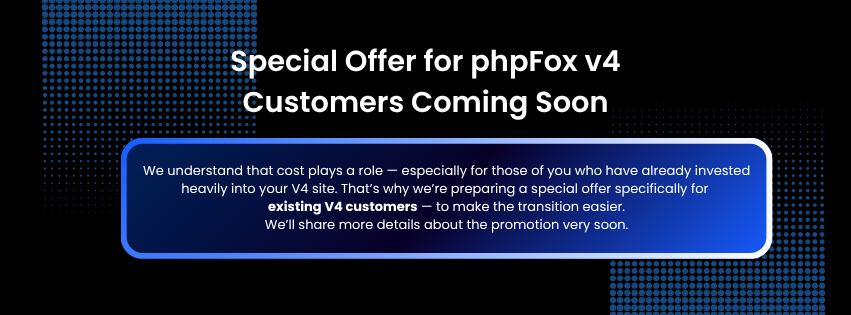
If upgrading has been on your mind, this might be the right time to start planning it. We will have a promotion coming soon next week. You can keep an eye on phpFox Blog to stay updated.
And regardless of your decision. Whether you choose to stay on V4 for now or start planning your move to V5, we want you to know that we don’t see this as a simple upgrade cycle.
We see it as part of a longer journey that many of you have been on with us for years.
And that’s something we don’t take lightly.