Starting an online community is easy. Turning it into something people happily pay for, and that keeps growing without wearing you out, is the hard part.
Most founders hit the same wall. The group is active, the members are friendly, and yet the revenue never quite shows up. Or it does, but every new member adds more work than income. A well-built monetized online community avoids both problems. It gives you a direct line to your audience, income you control, and no algorithm standing between you and the people who care about your work.
This guide walks through how to get there, step by step, from finding your purpose to choosing the right platform to keeping members around for the long run. So let’s dive in and take a closer look at each step below.
What it takes to build a community people will pay for
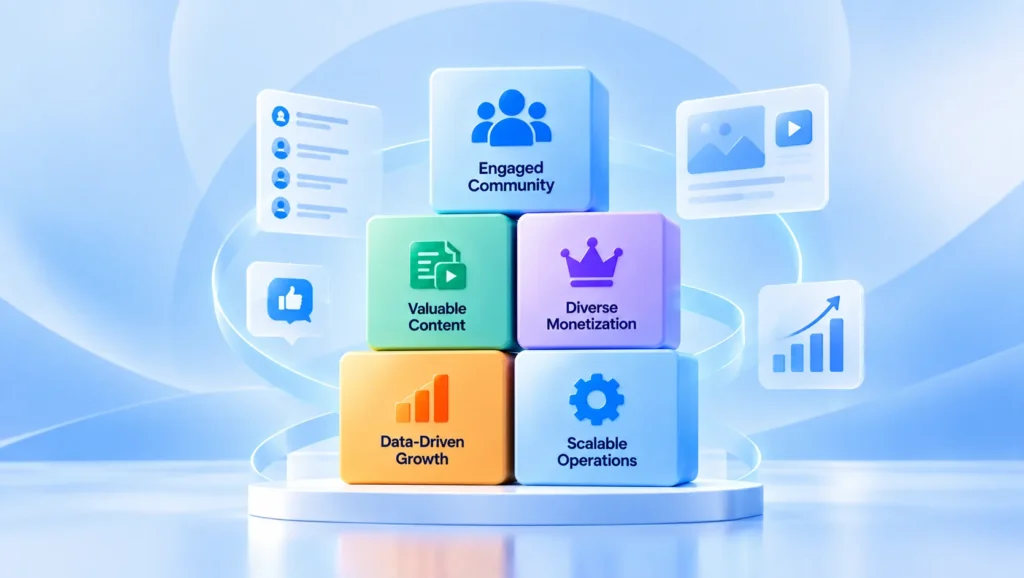
Monetization isn’t a feature you bolt on at the end. It grows out of a handful of things working well together:
- A clear reason to join. People need to understand, quickly, what they’ll get from being part of your community.
- A real understanding of your members. The more you know about what they want and struggle with, the easier it is to offer something worth paying for.
- A platform that can handle growth. The tools you choose today should still work when your community is ten times bigger.
- A pricing model that feels fair. Members should feel the value they receive is at least equal to what they pay.
When these pieces are in place, paying feels like a natural next step rather than a sales pitch. Members feel they’re investing in something they belong to, not just being sold to. And when one piece is missing, it usually shows up later: great content on a platform that can’t scale, or a loyal audience with no clear reason to pay.
8 Steps to build a monetized online community that scales
Now that you know what goes into it, let’s put it into practice. The eight steps below start with the foundations, your purpose and your audience. From there, they move on to the practical decisions: choosing a platform, picking revenue models, and keeping members engaged. Along the way, you’ll see a real-world example of how creators turn a community into a business, and we’ll finish with how to protect trust and prepare for growth.
Whether you’re starting from scratch or improving a community you already run, you can use these steps as a roadmap. Let’s begin.
1. Start with a purpose worth paying for
Every lasting community has a reason to exist beyond “people chatting.” Before you think about pricing, ask yourself three simple questions:
- What brings people together? It could be a hobby, a profession, a craft, or a shared challenge.
- What do members walk away with? A new skill, useful connections, honest feedback, or access to an expert.
- What can they get here that they can’t get for free elsewhere?
That last one matters most. If you can’t explain the value in a sentence or two, members will struggle to justify paying for it. Get this right first, and pricing becomes a much easier conversation.
2. Know your audience, and test what they’ll pay for
The best communities are built around real people, not assumptions. Look at the basics (age, location, occupation), but go further. What are they trying to achieve? What frustrates them? What are they already spending money on?
Then go where they already are: social media groups, forums, industry events, niche communities. Spend more time listening than talking. The questions people keep asking, and the problems no one answers well, are usually where your paid value lives.
Before building anything big, run a small test. Invite a founding group of 20 to 50 people, offer early access at a fair price, and see who says yes. Those first paying members will tell you more than any survey, and they often become your loudest advocates.
3. Choose a social network platform that can grow with you

Your platform quietly decides how far you can go. Something that feels perfect at 100 members can start to creak at 10,000, and migrating to a live community later is stressful for everyone involved.
When you’re comparing options, a good social network platform should give you:
- Ownership and control. Your brand, your data, your rules. You shouldn’t be a tenant on someone else’s terms.
- Built-in monetization. Payments and paid access should be part of the platform, not a tangle of plugins.
- Real engagement tools. Groups, feeds, chat, live streaming, and events are what keep members coming back.
- Room to customize. Your community should look and feel like your brand, not a template.
- Mobile access. Most of your members will show up on their phones, so a branded iOS and Android app makes a big difference.
- Reliable support. When something breaks, you need someone who answers.
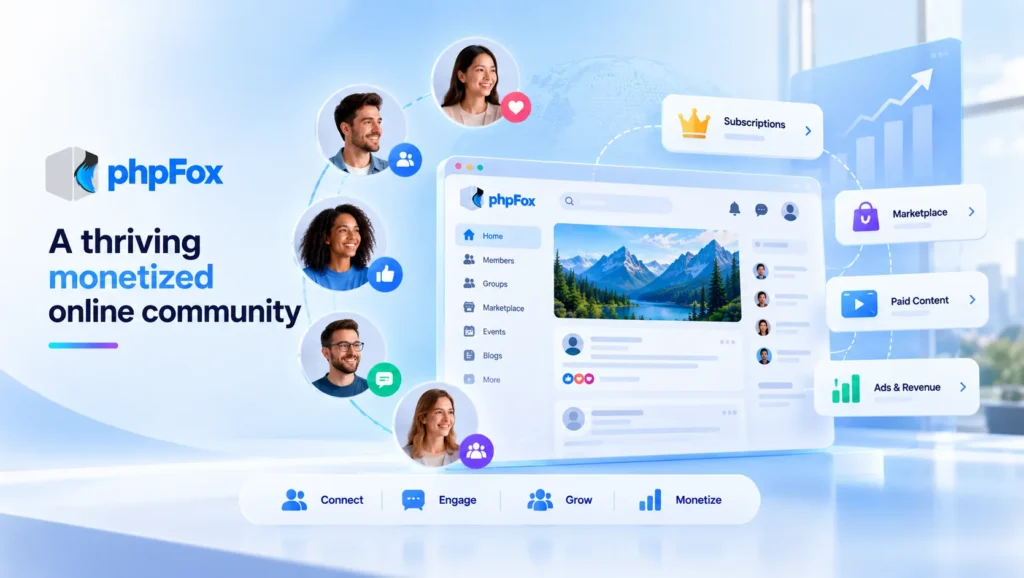
If your plan relies on recurring revenue, you’ll want a membership community platform specifically: one that handles gated content, tiered access, and paid plans natively. phpFox is built for exactly this. It brings social features like profiles, feeds, groups, and pages together with monetization tools in one product, so you’re not stitching separate systems together as you grow.
4. Pick revenue models that fit your community
There’s no single “right” way to earn from a community, and most successful ones combine a couple of streams. The most common ones are:
- Subscriptions and memberships. Recurring access to premium content, private groups, or perks. It’s the most predictable option and the backbone of most membership models.
- Paid content. Courses, e-books, video libraries, or exclusive posts, sold individually.
- A marketplace. A place for you (and sometimes your members) to sell products and services.
- Featured items and targeted ads. A way for members or sponsors to promote their work to a relevant audience.
- Paid events. Workshops, live Q&As, and masterclasses.
If you’re just starting out, keep it simple. Pick one core stream, usually a subscription, and add others once you see what your members actually value. Too many options at launch tends to confuse people rather than help them.
5. Give members a reason to stay
Getting someone to join is the easy part. Keeping them subscribed month after month is where a monetized community really proves itself, and it comes down to three things.
Exclusive content. Give members something they can feel: in-depth guides, video tutorials, templates, behind-the-scenes access, or structured courses.
Content from the members themselves. When people share their own stories, projects, and questions, the community stops depending on you for every post. It also builds the sense of belonging that keeps people around.
Live connection. Live streams, group chats, and events turn a content library into a place people genuinely want to be. A regular Q&A or webinar gives members a reason to show up every week, not just when they remember they’re paying for it.
6. Use case: How creators turn a community into a business
Let’s make this concrete. For podcasters, musicians, artists, and other digital creators, a branded community is a way to earn from a loyal audience without relying on ad-driven social feeds, where reach can change overnight.

That’s the idea behind phpFox’s Creators and Fans Digital Hub. The path from idea to income is refreshingly straightforward:
- Create your space. Set up a fully branded community with no third-party ads or algorithms.
- Share your content. Post videos, live streams, and stories your fans can’t find anywhere else.
- Engage your fans. Talk to them directly through comments, chat, and live interaction.
- Sell and monetize. Offer subscriptions, marketplace items, and exclusive paid content.
- Grow and promote. Feature your best work and use targeted ads to reach more fans.
What makes this model work is ownership. Instead of renting attention on platforms that can change the rules at any time, creators own the relationship with their fans, and the income that comes with it. It’s a model that’s resonating: phpFox reports over 1,995 creators already growing their communities on the platform.
7. Protect trust with good moderation and security
Members pay for a good experience, and a single bad one can cost you a subscriber. As your community grows, a bit of structure goes a long way:
- Clear guidelines. Spell out what’s welcome, what isn’t, and what happens when someone crosses the line.
- Well-prepared moderators. Give them the tools and the confidence to handle conflict fairly and consistently.
- Granular permissions. Control who can post, who can moderate, and who can access paid areas.
- Fast, friendly support. People who pay expect quick help when something goes wrong.
- Serious data protection. Payments and personal information call for enterprise-grade security.
Trust is what makes someone comfortable entering their card details. It’s also what makes them renew.
8. Build for growth from day one
“Scales” is the part of the title that’s easiest to overlook, and it’s usually decided by choices you make early:
- Own your platform, so growth isn’t capped or taxed by someone else’s rules.
- Go mobile. A branded native app puts your community on your members’ home screens and makes notifications work in your favor.
- Customize as you learn. Start simple, then adjust features, layouts, and member groups based on what people actually use.
- Connect your tools. Integrate the email, analytics, and payment tools you already rely on.
- Watch the numbers that matter. Retention, engagement, and revenue per member will tell you what to build next.
It’s also worth thinking about cost. Subscription-based platforms often charge more as you succeed. phpFox offers a one-time payment, which can make your long-term costs easier to predict as your membership grows.
Ready to build your monetized online community?
Building a community people pay for takes patience, but the path is clear: find a purpose worth paying for, get to know your audience, choose a platform that can grow with you, and keep earning your members’ trust.
phpFox brings the essentials together in one place, from social features and monetization tools to live streaming, mobile apps, and moderation, all under your own brand. You can try it with a 14-day free trial and see how it fits your vision.
>> Start your free trial or schedule a call to talk through your plans.
FAQ
What is a monetized online community?
It’s an online space where people gather around a shared interest or goal, and the owner earns revenue through subscriptions, paid content, a marketplace, events, or advertising.
What’s the difference between a membership community platform and a social network platform?
A social network platform focuses on connection: profiles, feeds, groups, and messaging. A membership community platform adds paid access, tiered plans, and recurring billing on top. The best options, like phpFox, combine both.
How many members do I need before I start charging?
There’s no magic number. Many communities start with a small founding group, because a handful of engaged, paying members is worth more than a large but passive audience.
Which revenue model should I start with?
For most communities, a recurring subscription is the simplest and most predictable starting point. You can add paid content, a marketplace, or events once you know what your members value most.
Can I run my community under my own brand?
Yes. With phpFox, you can run a fully branded community, including a native iOS and Android app, on your own terms.
Is there a free trial?
Yes, phpFox offers a 14-day free trial so you can explore the platform before committing.